The staff shortage in logistics is on everyone's lips. Following the peak of the Covid-19 pandemic, there is a lack of personnel in every corner. While this was limited to highly qualified IT specialists in recent years, almost all professional groups are now affected.
Logistics, in particular, is facing a severe shortage of personnel. Whether it's warehouse staff, order pickers, or drivers, there is a desperate search for skilled workers in all areas. Current data shows that approximately 60% of all logistics companies currently have vacancies they are unable to fill.
In logistics, this clearly means that less staff leads to longer turnaround times for freight forwarders, resulting in higher costs that squeeze margins. However, this cost risk is now intensifying and becoming a supply risk as well.

Long turnaround times increase costs for the logistics site
Implicitly, the recipient has always had to bear higher costs when things take longer. If a site is known among freight forwarders or suppliers for having unusually long turnaround times, transport costs have been increased. Depending on who pays for the transport, these costs end up either directly with the recipient or indirectly via the supplier, who passes the costs on to the recipient.
And this makes perfect sense: turnaround time is, of course, an essential component of every freight forwarder's profitability. If very long wait times occur at a site, the freight forwarder's margin deteriorates drastically, which must be offset by higher costs for the recipient. These costs are usually not explicitly stated but are implicitly accepted in a tacit agreement between the freight forwarder, supplier, and recipient.

The staff shortage in the warehouse has significantly exacerbated the problem. For logistics sites already experiencing issues with turnaround times in goods receipt, the staff shortage puts even more pressure on site capacity, leading to even longer wait times. This increases the implicit costs of each individual transport.
Driver shortage leads to supply risk
The worsening staff shortage is, of course, also noticeable on the driver side. As freight forwarders are forced to optimize their existing, scarce personnel, more and more are having to warn their receiving sites that they will no longer be served due to excessively high wait and turnaround times.
What could previously be bridged temporarily through increased costs is now developing into an extreme supply risk for logistics sites due to the driver shortage. Urgently needed goods, whether for retail or production, are no longer being delivered, not even at higher costs. It is obvious that this situation has a direct negative impact on revenue and profit.
How to increase your supply security
What can a logistics site do to ensure continued supply from carriers? The solution seems clear: reduce the turnaround time for every transport. The faster an arriving truck can be unloaded and get back on the road, the better it is for the carriers' bottom line.
Logistics sites have several levers they can pull here:
1. Reduce waiting times
The faster a truck can be unloaded upon arrival, the better. Time slot management systems can help coordinate the optimal timing between supplier, carrier, and recipient. This can significantly reduce waiting times.
Read more here: How DEBATIN reduced truck waiting times by 95%
Of course, traditional time slot management systems often come with disadvantages for carriers. Especially if they are not consistently used by all delivering carriers, delays in the process—and thus waiting times at the logistics site—can occur despite a booked time slot. Collaboration platforms like TradeLink can often be better suited than classic time slot software due to their high adoption rate among delivery partners.
“Shortly after the rollout at the first site, our suppliers were already asking us to implement TradeLink quickly at all other locations as well. Everyone simply wins. TradeLink is therefore now going live as the standard at all sites.” - Patrick Spiegel, Logistics Project Manager, Denner
2. Optimize processes
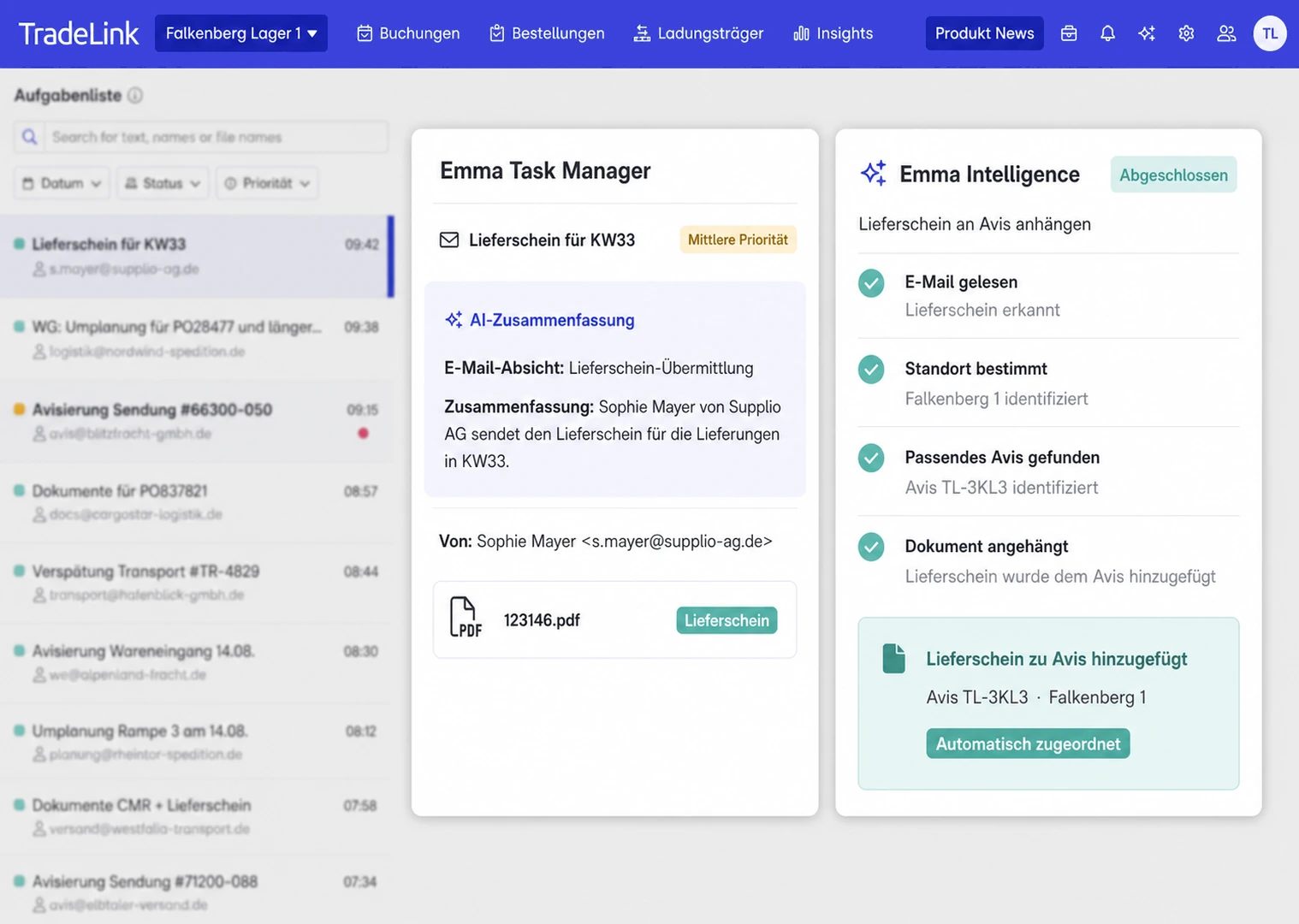
There is also significant potential for optimization on the process side. For example, if all delivery information is centrally accessible in advance, the appropriate loading dock for the load carriers can be identified much faster. This saves a great deal of coordination between the gate and the goods receiving department regarding which dock needs to be kept free for a specific truck. Furthermore, central, digital filing of delivery notes enables much more efficient workflows for every incoming goods process, thereby reducing lead times.

3. Combat your own skilled labor shortage
As described initially, the shortage of skilled workers exacerbates the situation at logistics sites and has a negative impact on lead times. Precisely because the lack of qualified personnel due to demographic effects will continue to be an issue for a long time, it makes sense to address how to attract and retain new employees under these challenging conditions.
One approach here is to make the work more enjoyable and avoid overtime. If you establish a collaboration platformin which all transports are scheduled according to available capacity, overtime can be drastically reduced.