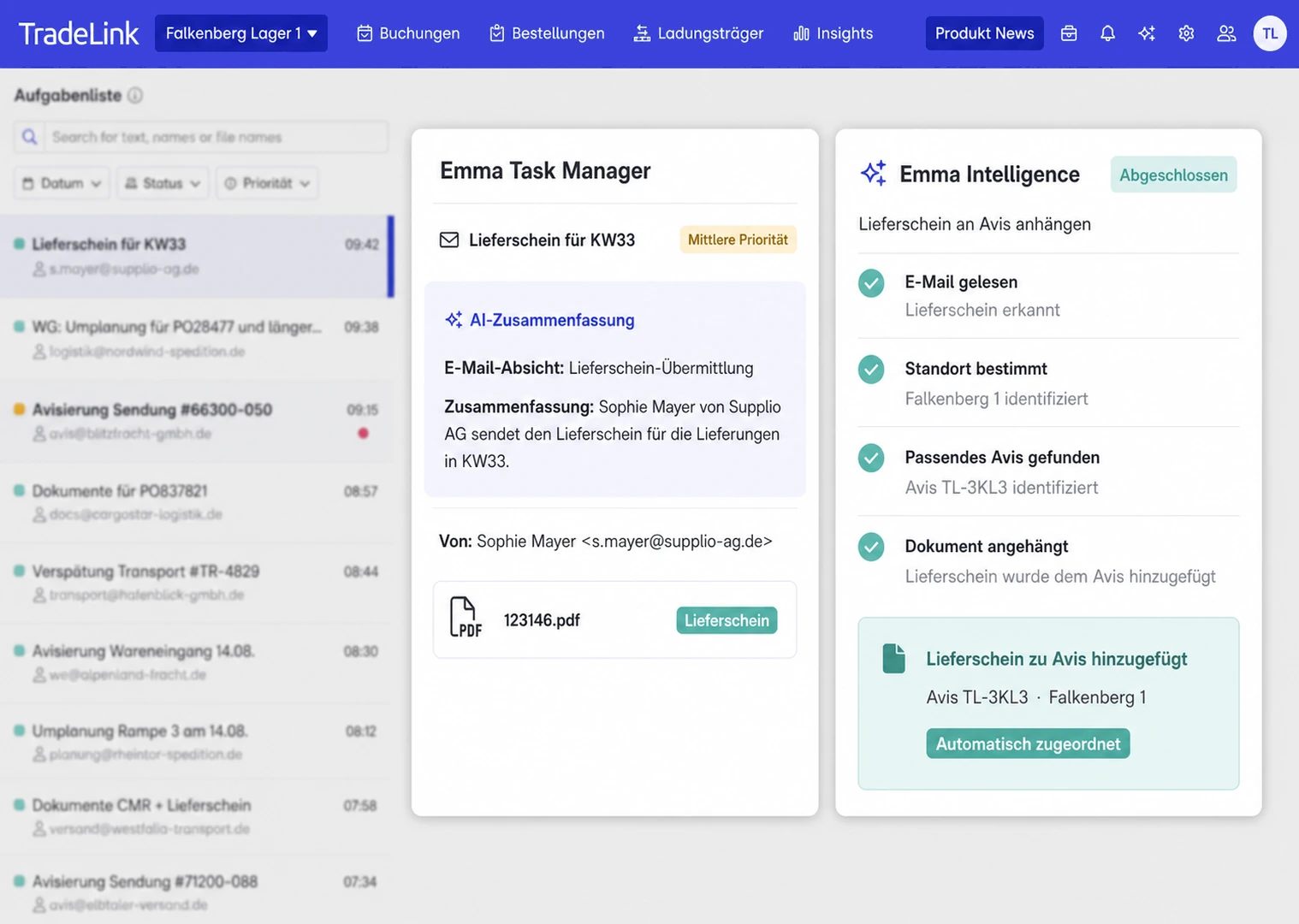
Logistics decision-makers are facing a mammoth task: using AI to significantly increase the efficiency and performance of their teams over the next three to five years. At the same time, the operating environment is becoming increasingly difficult due to labor shortages, rising costs, growing service demands, and ever more complex networks.
In many executive suites, there is a hope that AI can solve these challenges almost automatically. Buzzwords like "automation" or "autonomy" are thrown around quickly. But what does a good AI solution actually mean for the daily life of logistics teams? Instead of talking about hype, it is worth looking at the real problems that AI should meaningfully address. Three challenges appear in almost every logistics organization.
1. Skilled staff are tied up with too many unnecessary tasks
Well-trained specialists are one of the scarcest resources in logistics. Yet, many planners and dispatchers spend a large part of their day on activities such as:
- Searching for and maintaining data across different systems
- Manual coordination via email and phone
- Copying, consolidating, and checking information in Excel
A good AI solution should start here and provide context:
- How can information be automatically merged instead of being laboriously gathered by hand?
- How can standard queries and recurring tasks be specifically partially or fully automated?
- How can communication be structured so that the right information reaches the right people at the right time?
If these issues are solved step by step, planners and dispatchers can focus on what they were trained to do: making decisions and managing processes—instead of acting as data hubs or email coordinators.
2. From reactive daily operations to proactive control
Many logistics organizations are defined by one thing above all: constant pressure in day-to-day business. Ad-hoc disruptions, escalations, and "firefighting" dominate the daily routine. Typical examples include:
- Unforeseen shifts in the transport network
- Delayed or incomplete deliveries
- Bottlenecks in the yard or at loading docks
- High strain on warehouse and ramp staff due to constant rescheduling
A good AI solution helps break this reactive cycle and establish a proactive management mode:
- Relevant risks are identified and prioritized early on.
- Escalations are not just documented, but actively managed.
- Recurring patterns in disruptions become visible – and systematically addressable.
When AI helps stabilize routines where manual, ad-hoc decisions currently dominate, it provides structure. It offers insights into which cases require special attention – and which processes can be handled automatically.
Making hidden costs visible
Lack of transparency and reactive management create hidden costs that do not explicitly appear in any budget – yet place a significant burden on the organization. These include, among others:
- Transport damage and incorrect loading
- Special trips and express solutions
- Unplanned storage and idle times
- Short-term use of temporary staff
These costs arise in various areas and are often not clearly allocated. As a result, they remain invisible – and difficult to control.
This is where AI can play to its strengths:
- Consolidation of data from transport, warehouse, yard, and communication
- Visualizing correlations: Where do additional costs systematically arise? Under what conditions do escalations accumulate?
- Providing reliable facts for management, controlling, and audits
Instead of relying on gut feeling or isolated cases, logistics teams gain a data-driven view of their operational reality.
What good AI solutions in logistics have in common
Regardless of the provider, several principles can be derived that characterize a viable AI solution:
Focus on operational reality
No ivory-tower algorithms, but models that can handle real process data, actual disruptions, and practical constraints.
Faster, tangible impact
Relevant improvements should be visible within weeks – not after years of transformation projects.
Leveraging existing data sources
A good solution starts with what you already have: emails, ERP data, Excel, and existing tools – instead of requiring perfect data environments.
Transparency and traceability
AI decisions must be understandable for specialists: Which process was triggered? With what result? Where can intervention occur?
Humans remain in the driver's seat
Good AI does not replace experts. It removes the unnecessary, administrative parts of their work. Control remains with the human.
Anyone looking to introduce AI in logistics should not start with the technology, but with an honest analysis of the core problems:
- Where is valuable time being lost today?
- Where are a lack of transparency and ad-hoc decisions driving up costs?
- Where would a consistent, reliable view of operational reality make the biggest difference?
That is exactly where the path to a truly good AI solution in logistics begins. Ideally with TradeLink, of course ;)