Traffic jams, accidents, poor planning, and vehicle breakdowns: there are many reasons why trucks arrive at loading zones later than scheduled. However, delays at the ramp itself are also common, for instance when other delayed trucks arrive simultaneously or there is a shortage of personnel or loading equipment. If a carrier is forced to wait a long time for freight to be loaded or unloaded through no fault of their own, the transport company is entitled to compensation—a so-called demurrage fee. This is easily avoided through transparent, real-time communication.
Table of contents:
- What are downtimes and downtime costs in logistics?
- How can downtime and downtime costs be calculated for trucks?
- How can legal disputes over demurrage fees be avoided?
- How can companies avoid downtime fees?
What are downtimes and downtime costs in logistics?
If a truck or other means of transport cannot be used to move goods, for example due to extended waiting times at the loading dock, this causes economic losses for the affected transport companies and freight forwarders. In logistics, the period during which a vehicle is not operational is referred to as downtime. In addition to waiting times at the ramp, downtime can also be caused by repairs, accidents, technical faults, or vehicle damage.
If the transport company is unable to use the truck to transport further goods, this negatively impacts total operating costs and revenue. These are downtime costs. Furthermore, long periods of downtime can result in reputational damage. Once a transport company develops a poor reputation in the industry, it becomes more difficult to retain customers or acquire new business partners.
Section 412 (3) of the HGB (German Commercial Code) stipulates that transport companies are entitled to appropriate compensation—a so-called demurrage fee—if the downtime is excessive. The claim arises as soon as the carrier is forced to wait beyond the agreed loading or unloading time for reasons that do not fall within their own area of risk.
Since this claim is defined by law, the transport company's client cannot simply exclude it from their terms and conditions, as the Federal Court of Justice (BGH) ruled in 2010 (BGH, judgment of 12.05.10, Case I ZR 37/09).
Why the delivery date in your ERP is not enough—an analysis.
When are demurrage charges due?
For a transport company or freight forwarder to claim compensation from a customer, the agreed time frame for loading and unloading must have been exceeded. The carrier must have waited longer than the time actually agreed upon for loading or unloading.
Although the Commercial Code determines when a payment claim arises, it does not specify exactly when the relevant time window has been exceeded. In practice, this frequently leads to legal disputes over the remuneration of downtime.
The General Terms and Conditions for Freight Forwarding and Logistics Services (VBGL) provide guidance. These are set out in Section 5 (2) VBGL It is clear that a loading and unloading time of two hours is standard for vehicles with a gross vehicle weight of 40 tons. Only after this total of four hours does the actual downtime for the truck begin—and with it, the right to a demurrage fee.

How can downtime and associated costs be calculated for trucks?
Downtime can be calculated based on the regulations mentioned above: As soon as the carrier waits more than two hours for unloading or more than two hours for loading through no fault of their own, the transport company is entitled to compensation in the form of a service fee.
The compensation itself, however, cannot be calculated as a flat rate, as there is no clear legal regulation regarding the specific amount of the payment. Companies can, however, base their calculations on court rulings. For example, the Unna District Court ordered a shipper to pay a demurrage fee of 121.80 euros for a truck.
The truck driver had to wait at the company's ramp from 7:30 a.m. to 12:00 p.m., even though the company had indicated that waiting times were shorter early in the morning. The freight forwarder involved estimated a waiting fee of 35 euros per hour, plus VAT, for the period from 9 a.m. to 12 p.m. The court ruled in their favor (AG Unna, judgment of 25.01.07, Ref. 16 C 379/06).
The Thuringian Transport Industry Association (LVT) considers a demurrage fee of 50 euros per hour for a truck to be appropriate. Sales tax is added to this waiting fee. The total daily demurrage fee for a truck is calculated by multiplying the estimated hourly rate by the number of hours spent waiting, after deducting the reasonable two-hour allowance for loading and unloading.
How can legal disputes over demurrage be avoided?
Since the issue of standing fees frequently leads to disputes, long downtimes should be avoided from the outset whenever possible. Clear regulations in contracts and terms and conditions are helpful here. Additionally, every driver should verify the time with the person in charge at the loading zone upon arrival and note the arrival time on the bill of lading. If possible, they should have this arrival time countersigned by the responsible party.
In the event of a dispute, the tachograph or digital speedometer is used to verify the arrival time. If no loading or unloading takes place at all, or if the time taken significantly exceeds the appropriate duration, the truck driver must notify their dispatcher, who will then contact the customer in question. The dispatcher must then inform the customer of the claim and the amount of the waiting fee in euros.
If the customer is a regular client, it is advisable to contractually agree on a reasonable hourly standing fee for instances where progress at the ramp stalls.

How can companies avoid demurrage charges?
The answer is simple: by reducing downtime. But how can waiting times at the ramp be minimized? This can be addressed through effective time window management, which coordinates all loading and unloading processes at the ramp. The goal is to schedule truck arrivals at the warehouse so that long waiting times are prevented from the outset.
This not only helps avoid additional compensation payments like waiting fees, but also optimizes costs overall. Companies that manage time efficiently save up to 30% in costs for inbound goods and outbound goods processes, reduce their storage costs by 60%, and achieve 20% higher storage capacity.
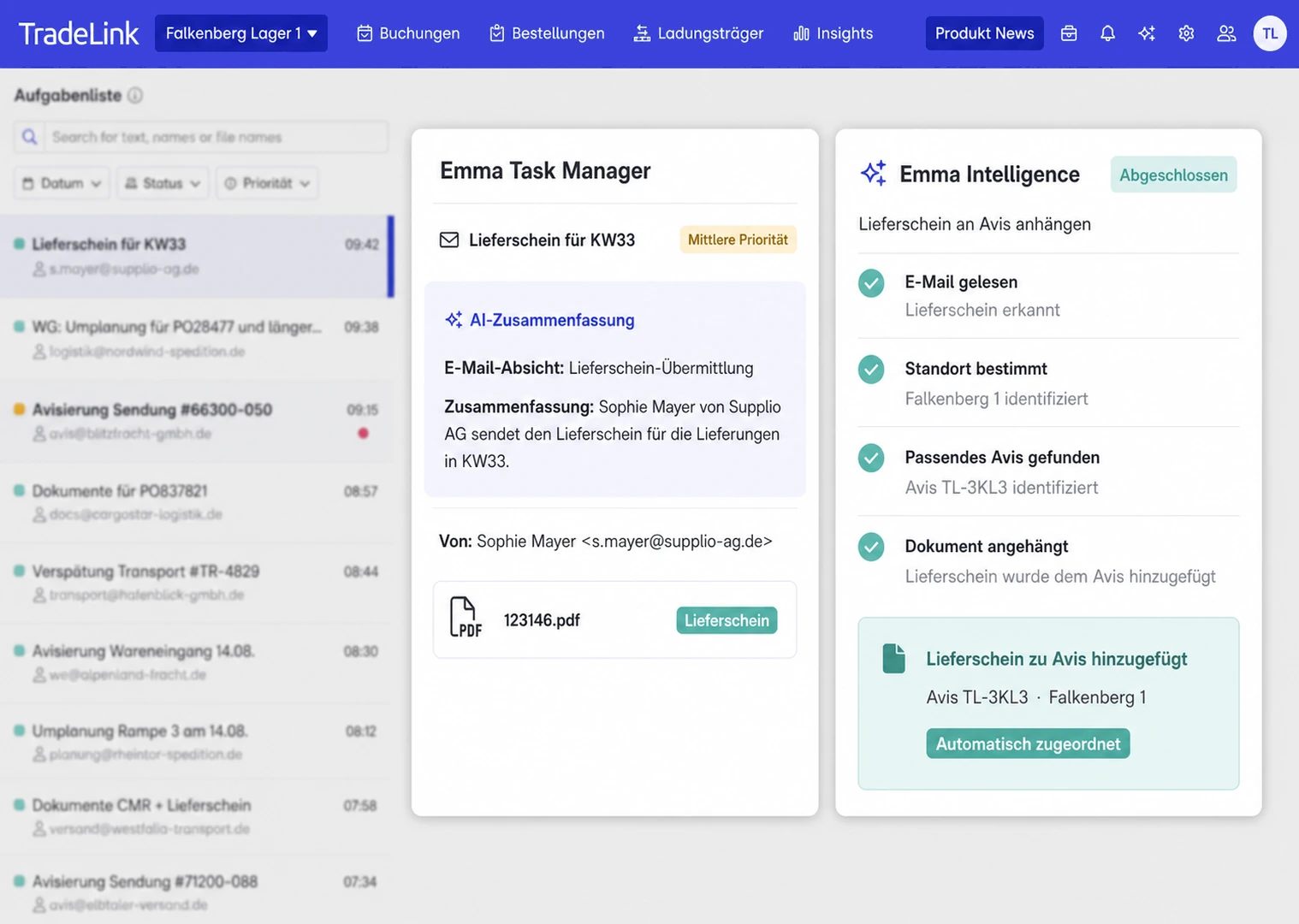
Innovative collaboration tools like TradeLink make this possible. TradeLink is a cloud-based platform where transport companies can communicate with internal staff as well as external partners and service providers in real time — because it is clear that communication is the key to success.
All relevant data is consolidated in one clear tool: carriers, employees, and partner companies have access to the information at any time. If there is a change in plans — for example, if a truck is stuck in traffic — the software automatically communicates every update to all affected parties.
Warehouse and ramp staff always know what needs to be done; drivers are informed which ramp to use, and schedule changes can be handled more flexibly through automated updates. This means there are no more surprises at the loading dock, and unnecessary, expensive downtime is avoided.