Quick overview: Goods receipt in logistics
- Definition: Acceptance, inspection, documentation, and storage of incoming goods
- Goal: Avoid errors, secure inventory, reduce costs
- Process: From notification and goods acceptance to quality control and system booking
- Challenges: Unplanned deliveries, incorrect documents, media discontinuities
- Solutions: Digital time slot management, barcode/RFID, clear responsibilities
- Result: Faster workflows, higher delivery capability, greater transparency
Tip: Standardizing and digitizing goods receipt increases efficiency while simultaneously lowering costs.
What is goods receipt and why is it so important?
Goods receipt is more than just unloading trucks. It is a critical junction in the supply chain that often determines the quality and efficiency of all downstream processes.
Whether in retail, manufacturing, or logistics, if something goes wrong at the receiving dock, it can lead to costly delays, production stoppages, or dissatisfied customers.
A modern, clearly structured, and digitally supported goods receipt process helps reduce costs, ensure material availability, and improve collaboration between all parties involved.
You might also be interested in: The digital delivery note at a glance
Definition: What does goods receipt mean?
Let's start with the basics: What exactly is goods receipt, or what is meant by receiving goods?
Goods receipt describes the moment a delivery arrives at a warehouse or plant and is processed from initial acceptance through to storage. It includes:
- Goods acceptance
- Quantity and quality inspection
- Documentation
- System entry
- Storage or forwarding
As part of the procurement process, the goods receipt process contributes significantly to smooth inventory management, accurate stock control, and the timely supply of production.
Let's take a step-by-step look at the goods receipt workflow.
Workflow: The goods receipt process in 5 steps
1. Preparation & time slots
An efficient goods receipt process begins before the goods reach the warehouse:
- Document reconciliation of purchase order, delivery note, and invoice if applicable
- Advance notification by the supplier, ideally via digital time slot management
- Resource planning: Scheduling personnel and loading bays to match the delivery date
2. Goods acceptance
- Verification of shipping documents (sender, recipient, items, quantities)
- Unique identification via barcode, RFID, or EDI
- Initial visual inspection for obvious transport damage
3. Inspection (quantity & quality)
- Quantity control: Ensure compliance with the order
- Quality inspection: Dimensional accuracy, function, temperature, or other product-specific criteria
- Documentation of discrepancies with timestamp and responsible party
4. Booking & Put-away
- Update inventory levels in the warehouse management system (WMS)
- Put-away into target rack, production buffer, or quarantine area
- Automated returns or claims processing for discrepancies
5. Special cases: Quarantine, returns
- Quarantine storage for quality defects, customs requirements, or pending clarifications
- Returns processes with clear workflows and digital documentation
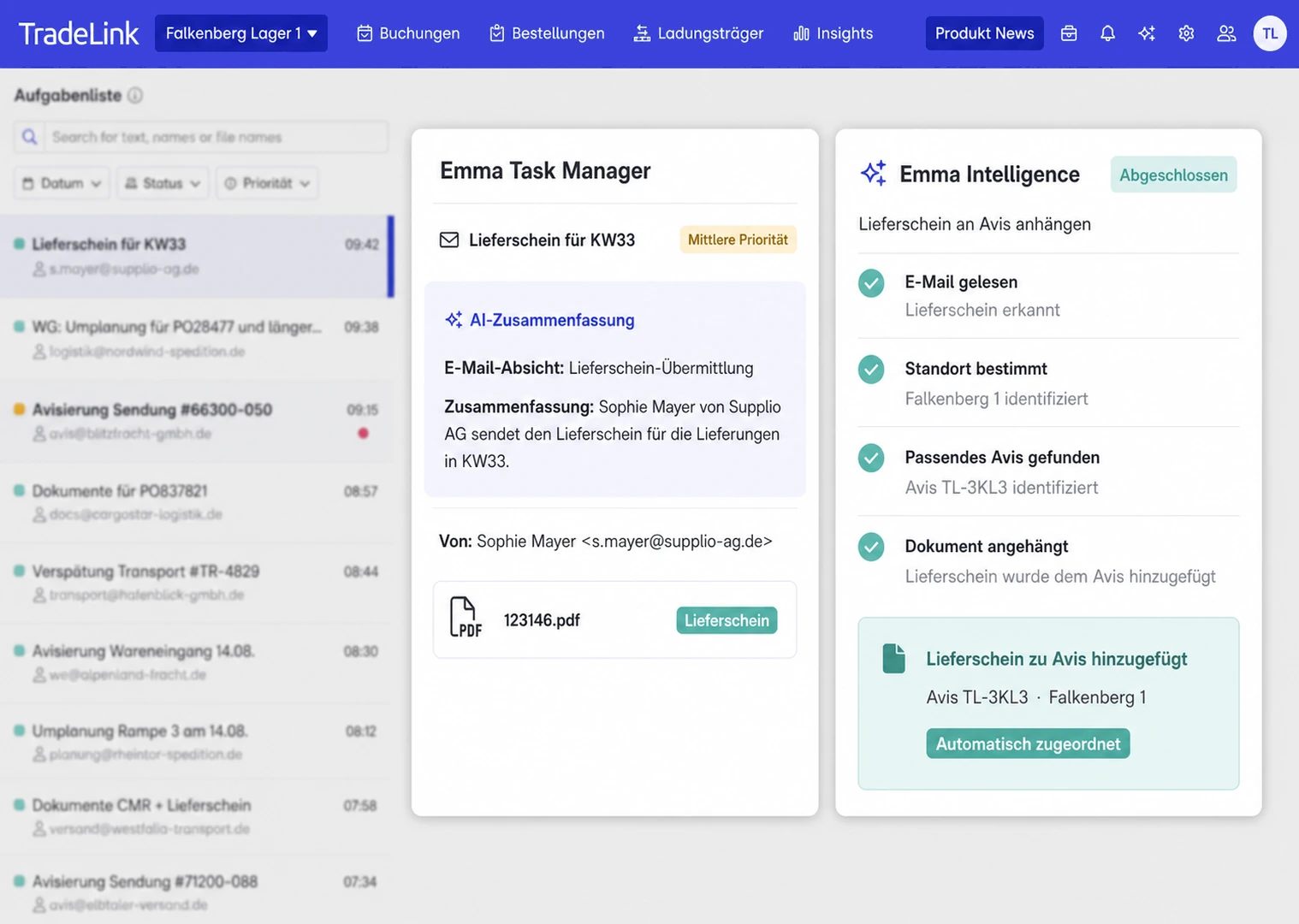
TradeLink as a digital solution for goods receipt.
Inspection and documentation in goods receipt
Goods receipt inspection is the primary quality filter in the warehousing process. It ensures that every delivery arrives not only complete but also in perfect condition. A structured workflow helps to avoid errors and reduce complaints.
Implement the right measures in your goods receipt process to ensure everything goes smoothly. For example:
- Checklists: Ensure a standardized, comprehensive inspection process.
- Inspection methods: Depending on the product – visual, functional, chemical, or dimensional checks.
- Defect reports: Record discrepancies immediately before goods enter the warehouse.
- Digital error reporting: Notifies purchasing or suppliers of issues directly.
- Quality management: Uses the results for supplier evaluations and long-term improvements.
Key roles and responsibilities in goods receipt
Clearly defined areas of responsibility prevent misunderstandings and process gaps. Goods receipt is a collaborative effort involving many stakeholders, from the warehouse team and quality control to administration.
These roles should not be missing:
- Goods receipt staff: Acceptance, inspection, documentation, storage
- Goods receipt management: Process control, personnel planning
- Quality inspectors: Inspection according to defined standards
- Returns coordinators: Processing of faulty deliveries
- Inventory managers: Accurate booking and storage location assignment
Close cooperation between the warehouse, purchasing, sales, and production departments is essential.
Special goods receipt types & processes
Not every delivery is the same. Different delivery types and business models require adapted workflows in goods receipt. Understanding these differences allows for the targeted deployment of personnel and resources.
- Planned deliveries: Deliveries notified in the system with high predictability
- Unplanned deliveries: Cause waiting times and additional organizational effort
- Consignment stock: Goods remain the property of the supplier until they are removed
- Vendor Managed Inventory (VMI): Supplier manages inventory levels at the customer site directly
Booking methods:
- Inventory-based booking (perpetual inventory method): every stock movement is documented continuously
- Expense-based booking: records incoming goods as temporary acquisitions for accounting purposes
Typical challenges in goods receipt
Even well-organized goods receipt processes encounter problems – especially when workflows are still manual or non-standardized. The most common stumbling blocks:
- Lack of time slot scheduling
- Unclear dock assignment
- Inadequate packaging or incomplete documentation
- Delayed system entries
- Media discontinuities between freight forwarders, warehouse, and purchasing
Optimization & Digitalization in goods receipt
Modern tools and clearly defined processes make goods receipt faster, more transparent, and less prone to errors. Digitalization is not just a trend here, but a genuine competitive advantage.
Quick improvements:
- Prioritize the inspection of sensitive goods
- Define storage-compatible packaging at the time of contract conclusion
- End-to-end digital communication with delivery partners
- Complete mapping of the process in the WMS
Technology deployment:
- Barcode and RFID systems for error-free identification
- Time slot management software to smooth out peak times
- Supplier portals for notification and document exchange
Tip: Use our free goods receipt checklist
Best practices & success stories
Companies that consistently optimize their goods receipt report significantly shorter waiting times and better resource utilization. These approaches have proven successful:
- Time slot booking tool: up to 94% on-time delivery and 65% shorter waiting times, resulting in optimized resource utilization
- Lean principles such as 5S and Just-in-Time to reduce waste
- Barcode & RFID technologies for faster, more accurate data capture
- KPI tracking: lead time, error rate in incoming goods inspection, average on-time delivery and waiting time, and cost per goods receipt
Also of interest: our industry-specific KPI benchmark reports for 2025
Goods receipt as a lever for efficiency
Goods receipt is not just a routine process, but a strategic lever in logistics.
Optimizing this area increases speed, quality, and planning reliability while simultaneously reducing costs.
By implementing clear processes, digital support, and transparent collaboration between all stakeholders, companies create a solid foundation for a reliable supply chain.
Optimize your goods receipt process – speak with our experts for a no-obligation consultation.
Contact our team of experts for a free consultation regarding your goods receipt process.