The warehouse is the hub of warehouse logistics. As a central interface, warehouse logistics manages the receipt of incoming goods and materials, internal transport, storage methods, as well as order picking and outgoing goods. Various tasks and processes occur simultaneously and must be planned, managed, and synchronized. In this article, you will learn about the tasks involved in warehouse logistics and the challenges logistics companies face.
Table of Contents
- What does warehouse logistics involve?
- What are the tasks of warehouse logistics?
- What other activities are performed in the warehouse?
- Challenges and goals in warehouse logistics
- Optimizing warehouse logistics tasks with TradeLink
What does warehouse logistics involve?
In general, warehouse logistics encompasses the planning, management, provision, and optimization of processes along the value chain. Specifically, it concerns how internal and third-party goods and materials are properly stored and managed in the warehouse. This also includes transport, location, and the Handling goods from incoming goods to outgoing goods.

What are the tasks of warehouse logistics?
Whether in containers, high-bay racks, or barrels: every logistics company must store goods and prepare them for further processing, such as shipping and sales. Every movement of goods must be documented precisely so that it is always clear which items are located where and in what quantities. Many processes and tasks in warehouse logistics run in parallel. These primarily include the following.
Goods receipt
The first task of warehouse logistics is the correct receipt of incoming goods and materials. When goods arrive at the warehouse, staff check them for defects, damage, and completeness. If there are no issues with the condition or contents, the staff add the goods to the inventory and store them. The goods are assigned a specific storage location and entered into the warehouse management system.
Storage and inventory control
During the storage process, every warehouse employee must be able to clearly identify where specific goods are kept. Employees who are in direct contact with the company's customers, in particular, must have constant access to current inventory levels.
As a rule, software is used for this purpose to enable precise tracking of inventory movements. Such a warehouse management system (WMS) is capable of optimizing location distribution, picking, and goods transport.
Order processing
Accurate inventory also plays an important role in order processing and subsequent picking. Even if goods have been in storage for a long time, staff must always know where they are located. When customers order a product, it must be marked in the inventory.
Since many tasks run in parallel in a warehouse, transparency is the foundation for optimized workflows—because only when staff know at all times where the relevant goods are located and how much is still available can orders be processed correctly and supply shortages avoided.
Picking
Organized order picking is a fundamental task in warehouse logistics. Specifically, it involves how goods and products are retrieved from shelves and transported, how orders are processed, and how the ordered items are packaged and shipped.
There are several ways to optimize these processes:
- By shelf height: Where are the products stored – on the floor, or on low, medium, or high levels?
- By the direction of the material flow: Do employees go to the product, or does the product come to the employee via automated systems?
- By the method used to collect different goods: On-demand picking, batch picking, zone picking, pick-to-cart, etc.
The best approach for a company depends on the business itself and other factors. These factors include the type and size of the goods, the frequency of inventory turnover, the number of daily incoming orders, and the available budget.
Goods issue
A final key task in warehouse logistics is the goods issue process: after picking and packaging, the ordered goods must be correctly addressed and sent via the appropriate transport route. The packaging must meet legal requirements, such as those regarding maximum weight and size. If the goods are to be delivered abroad, additional shipping considerations apply, such as customs clearance.
The accounting department records the outgoing goods in the ledger and documents the movement of goods with delivery notes and invoices.

What other tasks are performed in the warehouse?
In addition to the core tasks – goods receipt, inventory management, order processing, picking, and goods dispatch, there are other areas of activity in warehouse logistics.
Warehouse design
One major area of responsibility is warehouse design. This involves determining how the warehouse must be structured to meet the company's long-term requirements. Based on a detailed analysis of the current state, the company's future needs are determined by considering current conditions and potential challenges.
The design depends on various factors, such as:
- Product type, volume, and characteristics
- Frequency of inventory turnover and material flow
- Available storage space
- Potential site limitations
- Team composition
- Type of software used and degree of warehouse automation
- Selection of different warehouse types
- Selection of a storage system (based on product type, load unit, storage capacity, desired flexibility, and costs)
- Selection of handling equipment (manually operated equipment such as forklifts and pallet jacks, as well as automated systems such as conveyor systems and shuttles)
The goal of warehouse design is long-term planning that takes the warehouse's growth potential into account. Smooth warehouse logistics always rely on the interaction between employees, machines, work methods, and shelving systems.
Warehouse Safety
Daily warehouse operations involve a range of potential safety risks, both for personnel and for the goods themselves. Consequently, warehouse logistics tasks also focus on mitigating these risks and enhancing overall safety within the facility.
To achieve this, workstations are analyzed from an Occupational Risk Prevention (ORP) perspective to reduce workplace hazards associated with repetitive tasks through the use of automated systems and tools. Beyond preventing workplace injuries, the goal is also to minimize damage to goods caused by errors and improper handling.
Signals and sensors, guidelines for handling equipment, and proper maintenance of facilities and machinery all contribute to reducing safety risks.
Challenges and Goals in Warehouse Logistics
Operational warehouse logistics involves numerous simultaneous processes: staff must plan, manage, monitor, and synchronize goods receipt, storage, internal transport, order picking, and dispatch.
The goal is to ensure optimal use of warehouse functions by having all stations work in harmony. Goods and products must always be correctly positioned so that staff can locate them at any time—both on the shelves and within the system. When new goods arrive, they must be stored quickly and accurately so they are available for orders or transfers. Naturally, cost is also a significant factor in all these processes.
Optimizing processes and reducing costs requires high-performance systems. A high degree of automation is therefore essential and is expected to become the standard in warehouse logistics in the future.

Optimizing Warehouse Logistics Tasks with TradeLink
For logistics professionals and companies to work together and coordinate specific processes, a collaborative platform is essential—because processes can only be optimized and costs saved when all stakeholders in the logistics chain work together seamlessly.
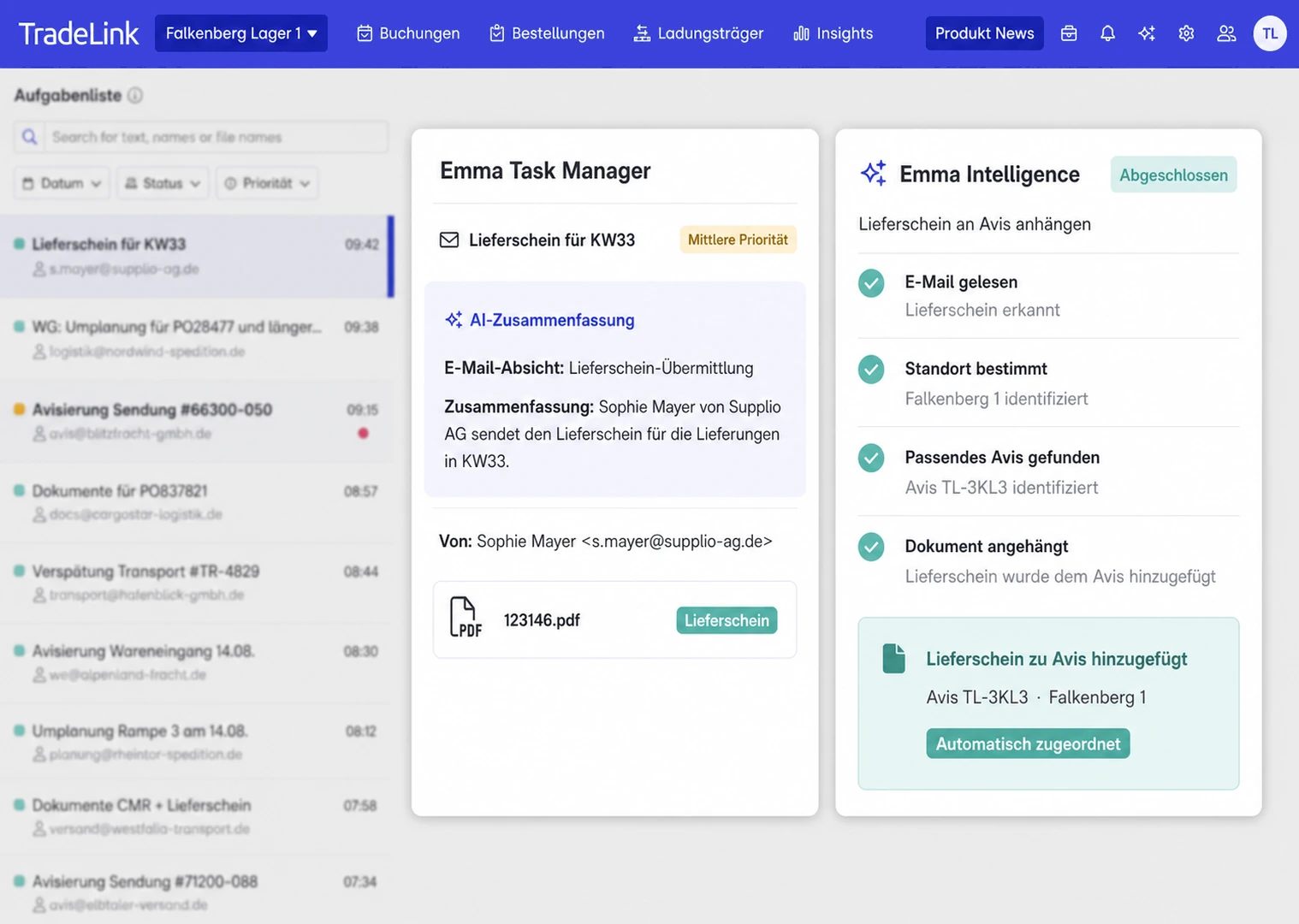
TradeLink’s cloud-based platform makes this possible: by automating coordination and providing data access to all parties, TradeLink simplifies collaboration across the entire supply chain. Thanks to TradeLink, the traditional, unstructured, and outdated coordination via email, phone, or fax is finally a thing of the past. All necessary information and warehouse documents are consolidated in one clear, intuitive tool.