Warehouse logistics is a central component of any functioning supply chain. It ensures that goods are efficiently stored, moved, and made available – from receiving to shipping.
In this article, you will learn:
- What is warehouse logistics? Simply explained
- Tasks in warehouse logistics
- Challenges in warehouse logistics
- Optimizing warehouse logistics: Processes and automation
- An overview of warehouse types
- Simplify collaboration in warehouse logistics with TradeLink
What is warehouse logistics? Simply explained
Warehouse logistics encompasses all processes related to the storage, movement, and distribution of goods within a warehouse. It is a sub-discipline of corporate logistics that ensures goods are available at the right time and in the right place.
Typical areas of warehouse logistics:
- Goods receipt
- Storage slotting
- Order picking
- Packaging & shipping preparation
- Goods issue
Digitization, automation, and modern warehouse technology, such as automated guided vehicles or digital warehouse management systems, have significantly improved efficiency and transparency in this sector.
Summary of warehousing goals
Smart warehouse logistics helps companies achieve several goals at once. While the actual delivery of goods is not part of warehouse logistics, it is dependent on it, which is why these goals are directly linked.
- Reduce delivery times: Once an order is received, goods must be retrieved from their storage location and prepared for shipment as quickly as possible to ensure high customer satisfaction.
- Increase delivery reliability: Punctual delivery is crucial for customers, both for end consumers and especially for businesses that rely on these goods for their own operations.
- Increase delivery quality: It is not just the timing of the delivery that matters, but also the quality of the shipment—such as the type, quantity, and condition of the goods.
- Increase delivery flexibility: Delivery flexibility describes the ability to respond to individual customer requests with tailored solutions—for example, regarding order quantities, delivery times, or transport options.
- Optimize the cost-benefit ratio: The goal is to keep storage costs as low as possible while maximizing benefits. The aim is to occupy storage space for as little time as possible and ensure a high turnover of goods. Long-term allocation of storage space for specific products can lead to the need for more warehouse space and, consequently, higher costs.
Transparency across all processes is a prerequisite for achieving these goals and optimizing general warehouse logistics. Only when all parties involved in receiving, storing, and shipping goods are aware of a delivery's status can short delivery times, high reliability, and a favorable cost-benefit ratio be achieved. Collaboration and communication along the supply chain are what create value-adding transparency that benefits everyone involved.

Warehouse logistics tasks
In a nutshell:
1. Warehouse design
- Planning storage zones (e.g., fast vs. slow movers)
- Scalability for future growth
2. Goods receipt
- Acceptance and inspection of incoming shipments
- System entry & routing to the correct storage location
3. Inventory & material management
- Inventory monitoring
- Stock transfers and replenishment processes
- Stocktaking
4. Order picking & dispatch
- Selection, assembly, and packaging of goods
- Shipping preparation, labeling, and handover to transport service providers
5. Safety & Quality Control
- Compliance with safety regulations
- Protection against loss, damage, or incorrect storage
-
The detailed version:
Warehouse logistics encompasses various tasks that help a company achieve these very goals. The focus is on implementing efficient processes along the value chain. What steps are taken when new goods arrive at the warehouse? How can goods be transported from there to their designated shelf space as quickly and with as little effort as possible – and how do you determine the ideal location for them in the warehouse in the first place? It is equally important to optimize the processes that take place when goods leave the warehouse.
A major area of responsibility in warehouse logistics involves warehouse design. How must a warehouse be structured to meet the company's long-term requirements? This question is preceded by a detailed analysis that determines the company's current needs while also anticipating future developments. A warehouse does not necessarily need to have more storage spaces than are currently required, but it should offer the potential for expansion to accommodate future growth.
The layout of the warehouse creates the foundation for efficient day-to-day operations. Other tasks include material management, order picking, inventory management, and ensuring on-site safety.
Challenges in Warehouse Logistics
In a nutshell:
Many problems do not arise within the warehouse itself, but rather in the interaction with external partners:
- Lack of transparency regarding deliveries (e.g., no ETA)
- Inefficient communication via email, phone, or Excel
- Bottlenecks due to labor shortages or lack of storage capacity
- High coordination efforts during short-term order fluctuations
All of this leads to Truck downtime, idle times, and rising costs.
The detailed version:
Careful planning, intelligent processes, and highly trained staff are the keys to efficient and smooth warehouse logistics. Even today, the biggest challenges in warehouse logistics lie not within the warehouse itself, but in its interaction with everything happening outside.
For instance, efficient inbound processes require knowing exactly when a truck will arrive with a delivery—and what goods it is actually carrying. Constant back-and-forth via email, phone, or Excel spreadsheets is anything but efficient. Pre-announced arrival times are frequently missed, tying up valuable capacity: truck bays are kept empty and staff are kept on standby, unable to be deployed elsewhere. This, in turn, creates indirect costs.
Added to this are challenges such as the shortage of skilled workers and truck drivers, sudden drastic spikes in cargo throughput, or the lack of balance between orders and the warehouse capacity needed to process them.

Optimizing warehouse logistics: processes and automation
Digitalization and the associated automation can help optimize warehouse logistics processes and address these challenges. Modern digital tools already allow for the intelligent management of internal warehouse processes. They are designed to make efficient work easier for on-site staff, enable high throughput, and create transparency in operations. But digitalization can do even more: it can simplify communication with third parties.

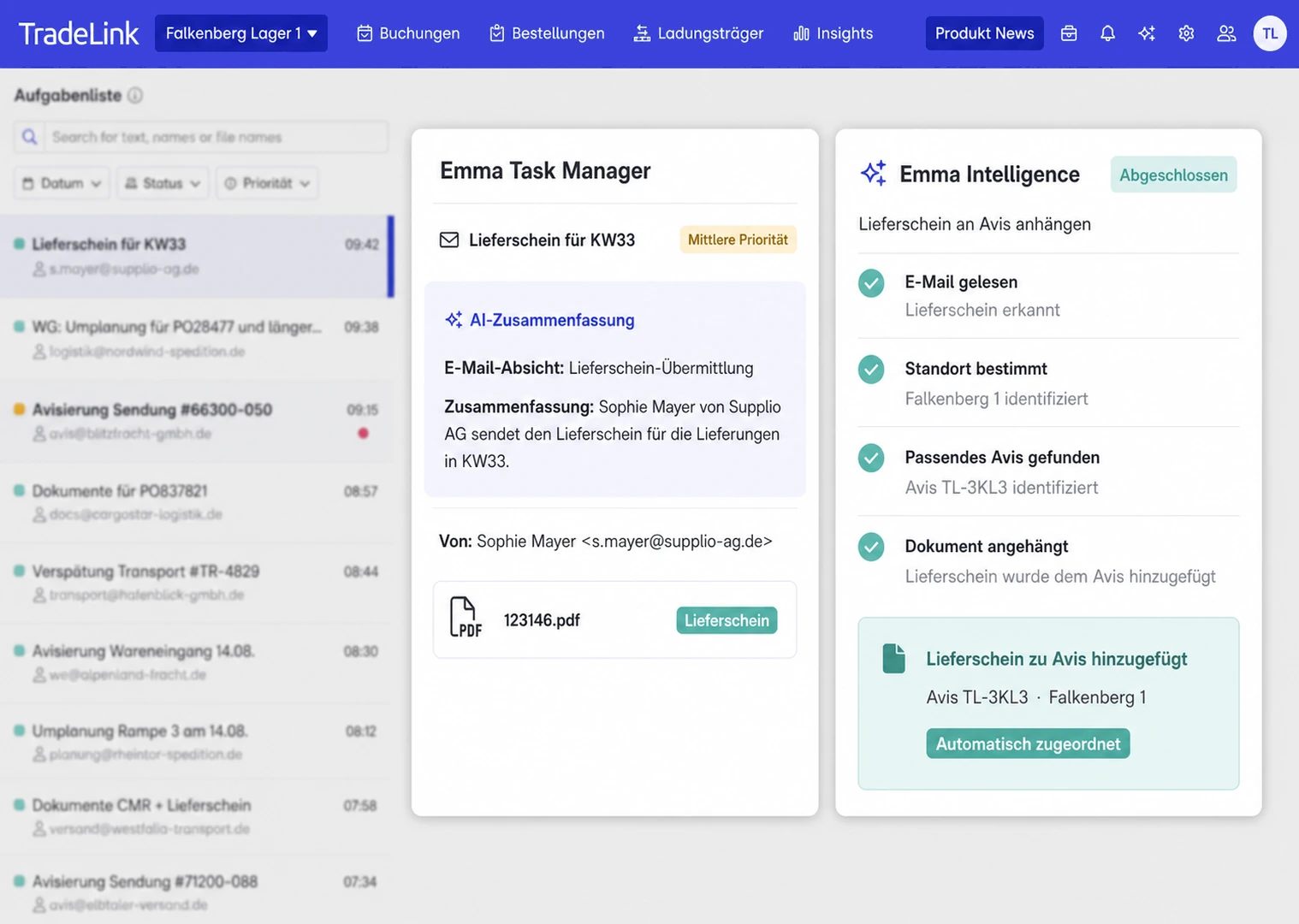
With TradeLink, we have developed a cloud platform that simplifies delivery coordination around your warehouse by creating transparency for all parties involved in one central location and enabling true collaboration—without the need for emails, phone calls, or Excel spreadsheets. This way, suppliers know in real time if their goods have arrived, site logistics knows when shipments are coming in, and sales knows when a customer can pick up their order.
New inspiration for warehouse logistics: trade fairs and trends
Like many other industries, logistics—and warehouse logistics in particular—is in a state of constant change, especially today. To keep pace with the competition or even stay one step ahead, you need to stay informed about current developments and engage in ongoing exchange. Trade fairs such as transport logistic, LogiMAT, or the Logistics Summit are great opportunities to discover new technologies and solutions and keep track of industry trends.
Download now: Your Excel template for your pallet account
An overview of warehouse types
Depending on the primary function of a warehouse, a distinction is made between different types, each of which offers different advantages and disadvantages and pursues different goals.
Inbound warehouse: Inbound or procurement warehouses are located upstream of production in the value chain and serve to provide materials for that very purpose.
Buffer warehouse: As the name suggests, buffer warehouses always serve as a link between two other stages in the value chain. Goods are stored here temporarily before being transported to the next station. Alternatively, they serve as transshipment warehouses for transferring goods from one means of transport to another.
Distribution warehouse: After production, goods wait in the distribution warehouse for delivery. When a customer places an order, the goods are picked and prepared for shipment.
The precise orientation of each warehouse depends on its role in the value chain and is tailored to the individual needs of the company and the stakeholders involved. The primary function of the warehouse determines its layout as well as all processes taking place within it to ensure smooth and efficient warehouse logistics.
Better collaboration with TradeLink
Improve your warehouse logistics measurably with TradeLink:
- 90% supplier adoption
- Reduced truck waiting times by up to 80%
- Clear communication for all stakeholders
- Ready to use quickly – no IT project required
Try it for free now and take your warehouse processes to the next level.

Conclusion
Efficient warehouse logistics is no accident. Those who understand their tasks, processes, and challenges—and work strategically with digital tools—can reduce costs, improve delivery quality, and secure long-term competitive advantages.