In recent years, digitalization has reached and transformed almost every industry. One area increasingly at the center of this digital revolution is warehouse logistics. Warehouse digitalization, also known as "smart warehousing," promises not only to optimize operational processes but also to significantly increase efficiency across the entire supply chain.
Table of contents:
- Goals of digital warehouse management
- Greater transparency in the digital warehouse
- The 10 most important benefits of electronic warehouse management
- The path to collaborative logistics
- It is high time for warehouse digitalization
Goals of digital warehouse management
Digital warehouse management aims to centrally control and manage inventory and goods movements. The digital warehouse system accesses all data in real time, creating an unprecedented level of transparency for all stakeholders.
With forward-looking warehouse software, all stakeholders come together on one platform, where they can optimize processes and handle all related documentation digitally and paperlessly. This optimizes overall warehouse processes and material flow.
Automation of warehouse processes
The digital transformation of warehouses is primarily manifested in the automation of previously manual processes. Modern warehouses are increasingly relying on automated storage and transport systems controlled by sensors, robotics, and artificial intelligence. This not only enables faster and more precise picking but also minimizes human error and reduces labor costs.
Use of data analytics and big data
Integrating data analytics and big data into warehouse processes allows for more accurate inventory forecasting and optimized resource allocation. By analyzing data, inventory levels can be monitored in real time and bottlenecks identified early. This leads to a reduction in excess stock and losses, as warehousing can be better aligned with actual demand.
Paper is a thing of the past – now it's time to go digital and smart
Even today, there are reportedly still warehouses where knowledge of all control and planning details is stored solely in the logistics manager's head. In many places, a mountain of paperwork that everyone involved has to literally fight their way through also seems unavoidable.
What is intended to ensure transparency and secure processes often has the opposite effect in practice: picking errors, for example, are noticed too late with analog management, and efficient planning of deliveries and pickups is no longer feasible today without digital tools like warehouse management software.
Added to this are ever-increasing demands for fast warehouse logistics processes. The rapid growth of online retail and omnichannel sales strategies in many companies are just as much a factor as tighter time windows, cost pressure, and limited personnel capacity due to the shortage of skilled workers.

More transparency in the digital warehouse
For logistics companies, it is therefore high time to embrace the trend of digitalization and leverage the associated potential. In the digital warehouse of tomorrow, transparency is not a coincidence, but a constant state: all internal and external stakeholders have access to optimized information at all times and are guided smartly through every process in a fully automated, digital warehouse.
Electronic warehouse management brings all these threads together. This includes managing deliveries, recording incoming goods, assigning and optimizing storage locations, and overseeing the entire picking and shipping process—right through to the subsequent replenishment of shipped goods. Warehouse Logistics 4.0—or Warehousing 4.0—digitally integrates the entire supply chain within warehouse management.
Fewer errors, more efficiency in warehouse management
Even though paper is still involved in many warehouse processes today, this will continue to evolve rapidly, moving from manual entry of picking orders and goods movements to digital control of the entire warehouse. This increases processing speed, reduces sources of error, and improves transparency regarding current inventory levels.
These effects, in turn, have a direct positive impact on the entire intralogistics operation. External transport companies are also integrated more efficiently. For example, because pickup times can be coordinated more precisely in a digital warehouse, waiting times and the wasted resources associated with them are drastically reduced.
The 10 most important advantages of electronic warehouse management
In a nutshell, digital warehouse management offers ten key benefits:
- Faster processes and optimized warehouse operations
- Reduction of picking errors and other sources of error
- Real-time transparency of current inventory levels at all times
- Optimized management of deliveries and pickups, leading to better use of staff resources and a reduction in unnecessary waiting times
- Time savings translate into sustainable cost reductions
- Increased productivity and safety in order picking thanks to paperless workflows
- Avoidance of unnecessary excess inventory
- Optimized, proactive scheduling
- Demand-driven staffing and improved warehouse utilization
- Securing and monitoring your own quality standards through fully digital documentation
Everyone involved benefits from effective, digital delivery coordination around the warehouse. Experience from companies like TradeLink shows that costs for and can be reduced by up to 30 percent. Waiting times for arriving trucks are cut by up to 95 percent – while maintaining 100 percent transparency across all processes.

Economic added value in the digital warehouse
In warehousing, transparency is worth its weight in gold and brings comprehensive economic benefits. After all, excess inventory of certain goods ties up unnecessary working capital, while shortages of other products jeopardize potential sales and customer satisfaction.
But optimized procurement is not the only positive impact of electronic warehouse management. Increased transparency benefits not only warehouse operators but also transport companies. Based on reliable information and better planning, they can reduce empty runs, optimize route planning, and significantly decrease the tedious, hours-long waiting times of drivers outside the depot.
Supply chain networking: The path to collaborative logistics
Warehouse digitization goes beyond simply optimizing individual warehouses and views the entire supply chain as a connected system. Through the use of the Internet of Things (IoT), warehouses can be seamlessly linked with suppliers, manufacturers, and distribution partners. This enables real-time communication, which in turn leads to improved coordination and faster responses to market demands.
With increasingly tight time slots in logistics and ever-higher demands, the need for better connectivity across individual process steps is growing. Warehouse management using printed paper lists? That will be unthinkable in the future.
Instead, the path to smart, collaborative logistics is opened up by software systems that bring all stakeholders together on an easy-to-use platform in the digital warehouse. Digitalization in Warehouse 4.0 helps to better utilize existing potential and make better decisions in real time based on high-quality information.
The benefits of collaborative logistics
- Improved efficiency thanks to a connected supply chain
- Real-time communication for better coordination
- Smart, collaborative, optimized potential utilization

Analyze the current situation and redefine processes
To get started with digital warehouse management, it is advisable to record the current status quo of workflows and interfaces and then define ideal processes in the next step. This approach allows you to make the best possible use of the positive effects of digitalization and achieve sustainable benefits. One thing is certain: meeting the high demands of e-commerce requires more efficient processes and a high level of transparency.
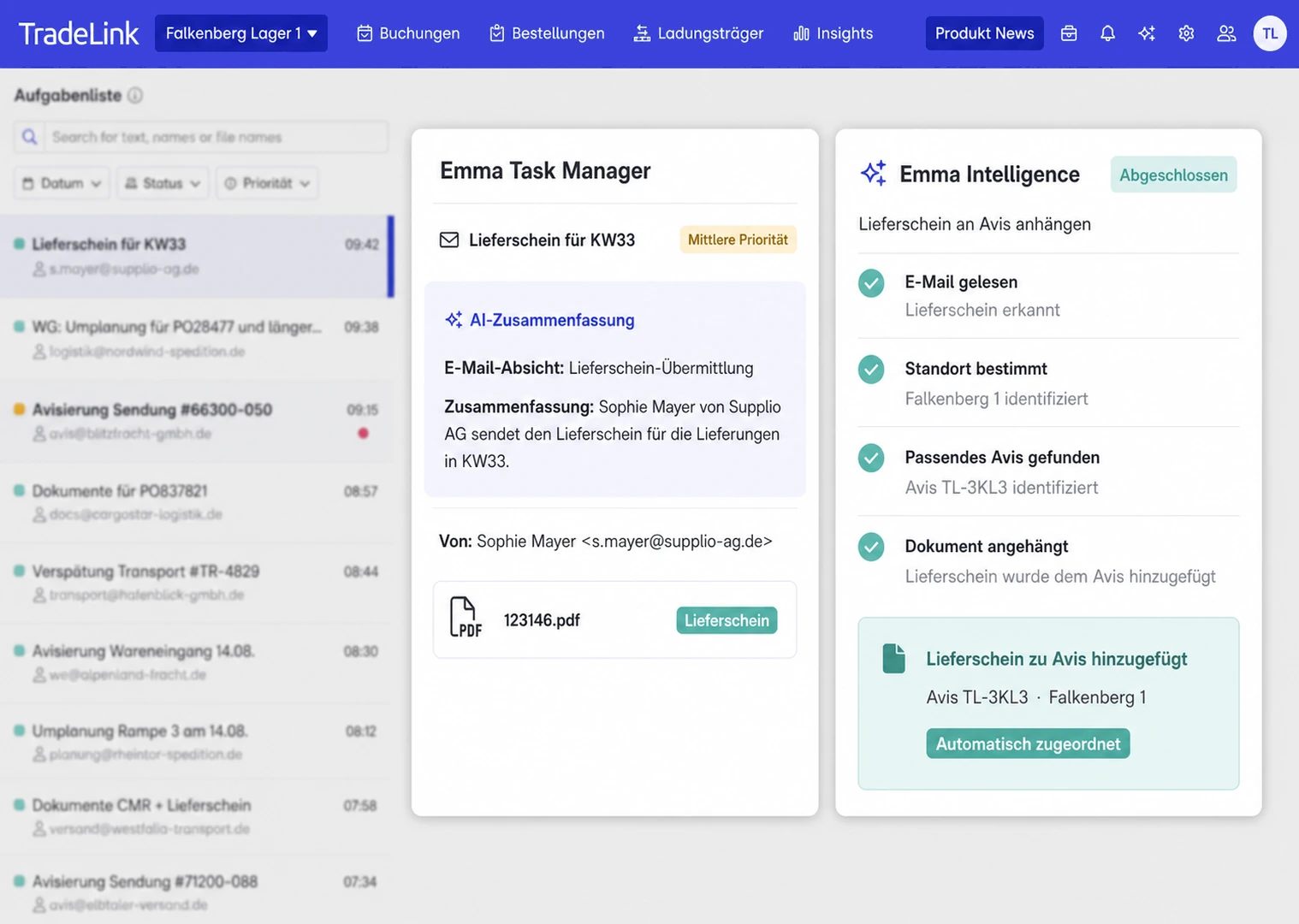
With TradeLink as an intuitive software solution for delivery coordination and logistics planning, your warehouse can also enter the digital age. Inventory levels are documented seamlessly at all times, and goods receipts and issues can be tracked precisely. The key performance indicators provided by the software also serve to scrutinize workflows and initiate continuous logistics optimization.