As soon as an order is placed, the clock starts ticking. How quickly does the ordered merchandise actually reach the customer, and how long do the intralogistics processes and the actual transport take? In logistics terminology, this is referred to as lead time. The following article explains the term, provides background information, and offers tips for optimizing this key metric.
Table of contents:
- The importance of lead time
- Lead time: Definition of the technical term
- Logistics lead time and its impact
- Calculating warehouse delivery time
- Measures to reduce lead time
- Lead time: Efficient warehouse logistics makes the difference
The importance of lead time
Freshly unloaded from the truck, components from suppliers flow directly into ongoing production: the automotive industry pioneered this model of tightly synchronized logistics processes, known as "just-in-time delivery," years ago. The advantages of this concept are obvious: less inventory means less tied-up capital. Production can be managed much more flexibly and in line with demand. Furthermore, storage capacities are outsourced from the manufacturer's plant to the suppliers.
Time-critical transport is on the rise
Today, "just-in-time" has become a standard expectation across the entire logistics sector. The e-commerce boom, digital procurement, and integrated process chains in many industries have led to a continuous increase in the share of time-critical transport orders—a trend that continues to grow. In many cases, fixed, guaranteed time slots for delivery are mandatory. In this context, lead time is a crucial variable.
Lead Time: Definition of the technical term
Lead time refers to the period between receiving a customer order and delivering the goods. The formula is:
Delivery Date – Order Date = Lead Time
For the sake of simplicity, lead time is usually expressed in calendar days. Specifying the lead time has a direct impact on all process steps along the entire supply chain: from order processing and picking to assigning the transport order and ensuring its timely execution. Individual time targets are set for each step, and compliance with these is monitored.
Importance of lead time as a key metric
Given today's logistical processes, which are designed for maximum efficiency and speed, lead time is of essential importance. Alongside metrics such as delivery accuracy, storage and transport costs, inventory turnover frequency, and inventory accuracy, it is one of the central logistics KPIs. From this, company-specific Key Performance Indicators (KPIs) can be derived as target values.
Lead time in logistics and its impact
Lead time has a direct impact on various processes, not just in logistics. Therefore, this value should be known across a wide range of departments within the company:
- Sales requires a reliable lead time to provide customers with accurate delivery commitments.
- For procurement, knowing supplier lead times is essential to ensure sufficient inventory levels at all times.
- Production planning must account for transport lead times to ensure that just-in-time manufactured goods are ready for shipment on schedule.
- For warehouse logistics and distribution, lead time serves as the internal benchmark that must be met in daily operations.
Calculating lead time in the warehouse
A particular challenge in calculating lead time is that, in addition to internal stakeholders such as order picking teams, external partners—especially transport companies—must also be involved in process planning. This includes precisely scheduling delivery and collection windows in warehouse logistics to reduce or, ideally, completely eliminate downtime, internal resource overload, and frustrating, costly truck waiting times.
Lead time as an indicator of service quality
Precise knowledge and control of lead time are indispensable for planning logistical processes optimally and efficiently. To achieve this, commitments from suppliers and transport companies must be continuously compared against actual data from delivery history. Lead time is also a key indicator of a company's service quality.
A rule of thumb: the shorter the lead time a supplier can promise and maintain for their clients, the higher their service level. This is particularly important in time-critical production processes (just-in-time) or for urgent spare parts deliveries, where the goal is to minimize unplanned equipment or machine downtime and the associated financial losses.
Reliably calculating lead time
The shortest possible lead time supports reliable demand planning and creates the conditions for customers to reduce their inventory levels. Efficient warehouse logistics thus benefits both business partners. Given megatrends such as e-commerce, Logistics 4.0, omni-channel distribution, and automated procurement, lead time is becoming an increasingly important logistical metric.
.jpeg)
Measures to shorten lead time
To identify potential for improvement, the first step is to break down the total lead time into individual stages along the process chain: How long do production, delivery preparation, order picking, and the actual transport process take? Only with precise data and knowledge of all sub-processes, especially in the Warehouse logistics, times can be further reduced.
Optimization potential in warehouse logistics
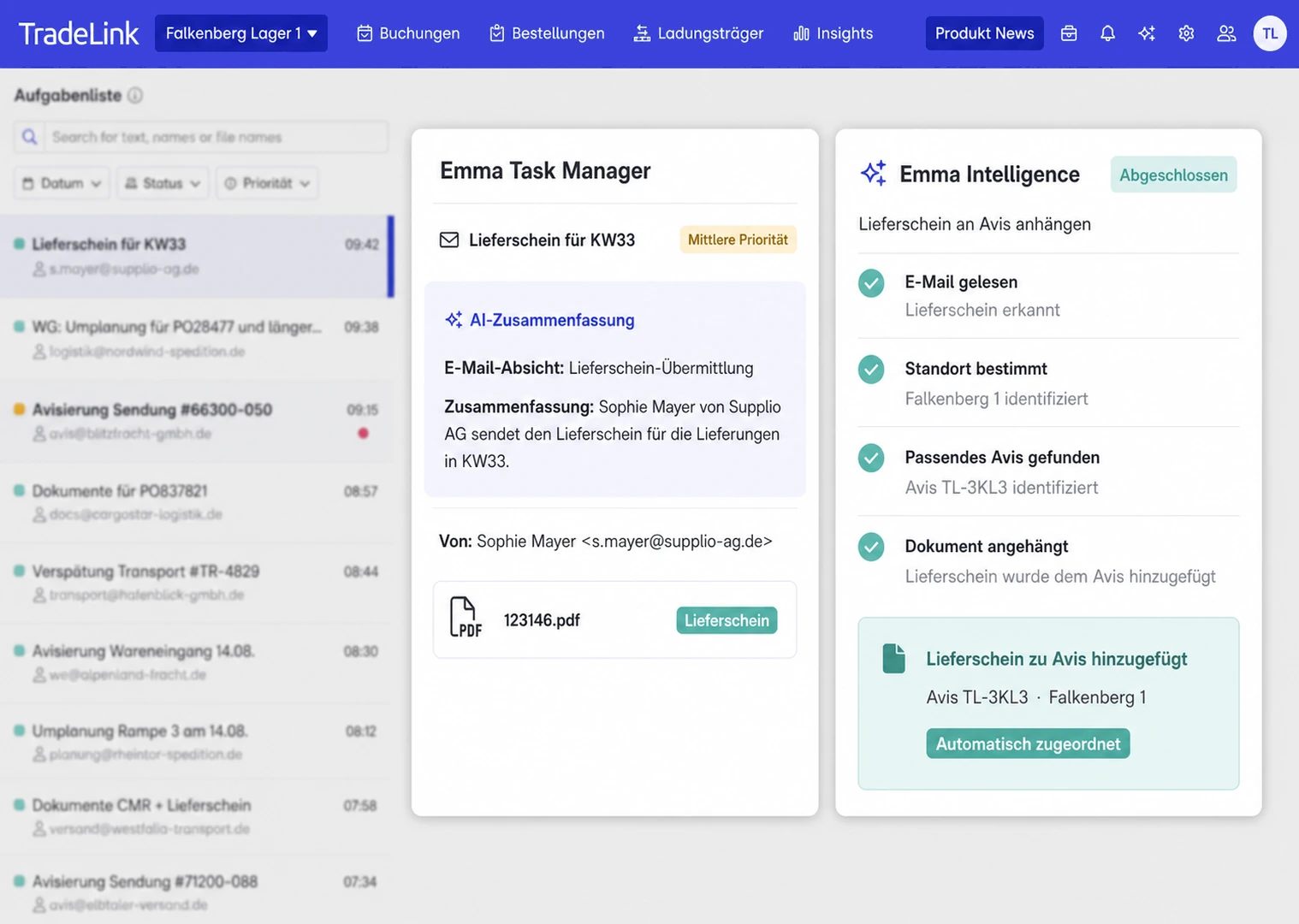
Intralogistics holds a wide variety of opportunities for improvement: from material flow and optimized storage location layouts to the organization of picking stations. A key tool here is suitable warehouse management software like TradeLink, which intuitively brings various stakeholders together on a single platform and provides them with valid, real-time data.
This allows sources of error and bottlenecks to be identified as early as possible so that appropriate countermeasures can be taken. The planning of all delivery and collection processes is of central importance here. Experience shows that better scheduling can lead to significant savings and time advantages. Cost optimizations of up to 30 percent in warehouse logistics are just as achievable as a 95% reduction in waiting times for arriving trucks.