Warehouse logistics involves receiving goods and merchandise, inspecting them, and storing them properly upon arrival. Specialists organize delivery routes, load orders, and ship them to customers. At the heart of all these operations is the optimization of logistical processes—because only when these run efficiently can warehouse functions be utilized to their full potential. In this article, we reveal the goals of warehouse logistics beyond process optimization and how best to achieve them.
8 Goals of Warehousing
In every warehouse, goods and materials are received and checked for usability. The primary goal is always to ensure that the storage and transport of goods make the material flow faster, more efficient, and as error-free as possible – from goods receipt to goods dispatch. In summary, warehousing pursues eight goals:
- sufficient inventory
- short delivery times and high delivery reliability
- optimal storage capacity
- good cost-benefit ratio
- high delivery flexibility
- optimized process execution
- reduction of storage costs
- increased information and communication capability
Sufficient inventory
The first goal of Warehouse logistics is to ensure that all required goods, products, and raw materials are always available in sufficient quantities . If a supplier experiences delivery difficulties or if supply shortages occur due to seasonal fluctuations, a well-stocked warehouse can help compensate for these variations.
Short delivery times and high delivery reliability
Another goal of warehouse logistics is to achieve short delivery times paired with high delivery reliability. On one hand, the time span between order placement and shipment of goods should be as short as possible . Production cycles, order processing times, the availability of ordered goods in the warehouse, and delivery reliability are all factors that influence delivery time.
High delivery reliability, in turn, ensures that promised delivery dates are actually met . This is also influenced by various factors, such as the reliability of workflows and stock availability. High delivery reliability is a fundamental prerequisite for customer satisfaction and loyalty. It is therefore often more decisive than the price of the goods.

Optimal storage capacity
Another goal of warehouse logistics is to ensure optimal storage capacity through efficient processes and advance planning. This determines the total amount of goods the warehouse system can accommodate. To determine the required storage capacities and financial resources, precise advance planning based on demand analysis, market observation, and growth forecasts is essential.
Data analysis—such as order quantities, procurement lead times, reorder levels, and safety stock—helps warehouse logistics specialists optimize processes and manage warehouse capacity economically sound to use. Improved ordering processes offer the opportunity to manage inventory in a profit-optimized way.
High cost-benefit ratio
This point is also one of the goals of warehouse logistics: an optimal cost-benefit ratio. Achieving the best possible cost-benefit ratio requires a well-thought-out and customized storage strategy. This defines the rules for how and in what order incoming and outgoing products are delivered, picked, and shipped.
Using suitable storage racks and IT systems, employees can monitor and control loading and unloading processes at the warehouse. When choosing a suitable storage location system , both fixed and dynamic slotting systems are available.
All storage strategies aim for a good cost-benefit ratio. For example, if the warehouse contains expensive components that are rarely needed but frequently require adjustments, it may be more sensible to manufacture them only when needed rather than storing them for an extended period.
High delivery flexibility
Another goal in warehouse logistics is to ensure high delivery flexibility. This refers to the delivery system's ability to respond flexibly to customer requests – whether regarding delivery time, changes to the ordered product quantity, or transport options.
Regarding delivery time, the terms "just-in-time" and "just-in-sequence" play an important role. "Just-in-time" means that a required product is delivered at the exact time and in the exact quantity to keep the costs and effort of storage at the processing site as low as possible.
The "just-in-sequence" delivery method pursues the same goal – only the seamless procurement of the required goods is further refined: the goods are not only delivered at the right time and in the right quantity, but also delivered in the correct manner to the right locationso that it can be processed immediately upon arrival. This means the supplier must also ensure the products are packed and loaded in the correct sequence.
To ensure such high delivery flexibility and smooth procurement of goods, electronic data interchange between the buyer and supplier is essential.

Optimized process execution
Within the warehouse itself, it is also important to continuously optimize ongoing processes. Factors such as the handling equipment used (e.g., conveyor systems, forklifts), the movement of goods within the warehouse, or the steps involved in recording goods in the inventory management system are just a few examples that can be examined for potential improvements . Optimizing the logistical processes within the warehouse is therefore an equally important goal in warehouse logistics.
Reduction of storage costs
Ultimately, all goals and measures are aimed at reducing the time and costs associated with various logistical processes. Reducing storage costs is therefore a fundamental objective in warehousing, which can be achieved through various methods, analyses, and measures.
Some possible solutions include:
- Determining optimal order quantities
- Switching to just-in-time delivery
- Shorter internal transport routes
- Reduction of storage risks (e.g., unsecured objects and goods; damaged shelving)
- Automation of orders
- Outsourcing of work processes
Increased information and communication capabilities
All stakeholders involved in the value chain require a high-performance network for transmitting information and data – because only with high information and communication capabilities is it possible, for example, to deliver required parts with minute-by-minute precision. If suppliers are informed about consumption at the manufacturer or customer level "just in time," inventory levels can be reduced thanks to modern communication systems.
How to achieve your warehouse logistics goals
Warehouse logistics is facing ever-greater challenges: growing customer expectations, increasing demands for delivery times and availability, a wider variety of products, shorter product lifecycles, and changing requirements for suppliers due to globalization and offshoring are just a few of the tasks that warehouse logistics must address.
These high standards can only be met if all stakeholders involved in the value chain work together and all processes function smoothly – from purchasing, goods receipt, warehouse logistics, and sales, all the way to delivery to the customer.
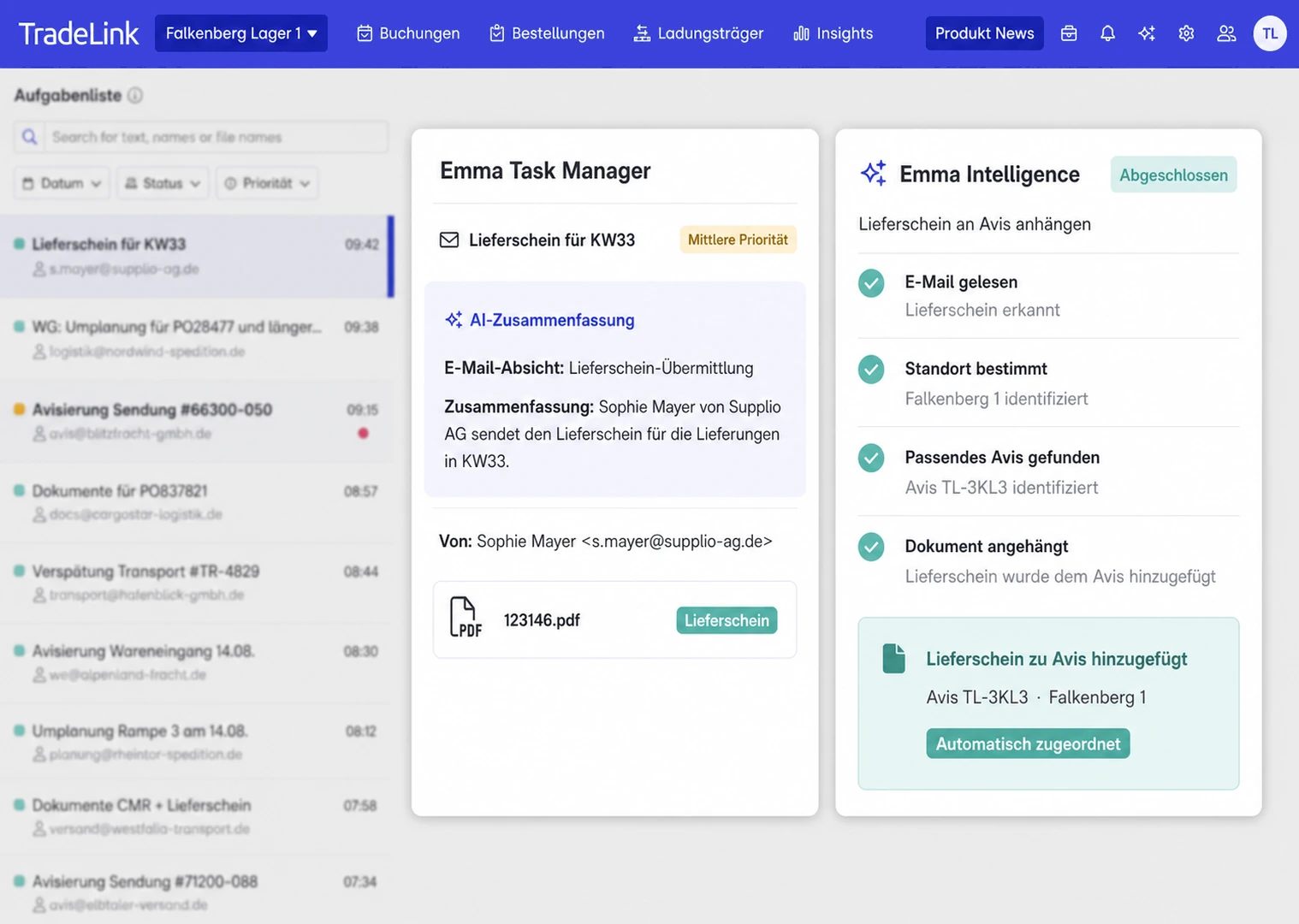
To achieve ambitious goals like continuous cost reduction, a high degree of automation is essential – including in how different stakeholders collaborate. With TradeLink, you can increase productivity – because all coordination tasks are simplified and partially automated thanks to our cloud solution.