The efficiency of a warehouse, the leanness of its processes, and the resulting time and cost factors depend significantly on where goods are stored and the rules governing that storage. One option is known as chaotic storage. In this article, we explain what this means, how a chaotic warehouse functions, its pros and cons, and why it is not nearly as chaotic as the name suggests.
Table of Contents:
- What is a chaotic warehouse? Definition
- Chaotic storage: Requirements
- What are the pros and cons of a chaotic warehouse?
- Who benefits from storage methods like chaotic warehousing?
- Optimizing storage systems and chaotic warehousing
What is a chaotic warehouse? Definition
A chaotic warehouse—also known as a dynamic warehouse—is a storage method where goods are placed in any currently available space. Placement is independent of product group, manufacturer, or material.
Products are not assigned a fixed storage location. However, contrary to what the name might imply, chaotic storage follows a strict order. While there is no fixed assignment of a product group to a specific location, the system is organized based on inventory turnover and the classification of A-B-C products.
When goods arrive at the receiving dock, they are assigned to an available space. To track the product, it is labeled with a unique barcode that is linked to its specific storage location. This ensures that staff always know exactly where every item is located. For this to work, a warehouse management system is essential.
Chaotic storage is the opposite of traditional static storage. The latter is characterized by the fact that every stored item is assigned a fixed and predetermined place within the storage system.
Chaotic storage: Requirements
To ensure that a chaotic warehouse does not become truly "chaotic" in the literal sense, warehouse staff must be able to digitally record both the goods and the storage locations.
In addition to efficient warehouse management software, chaotic storage also requires the following:
- Goods and the pallets used to transport them require a unique barcode.
- Storage locations are marked with coordinates that can be digitally integrated into the warehouse management system.
- All warehouse movements are digitally documented and monitored.
- Warehouse staff are equipped with mobile barcode scanners.
- Staff are trained in chaotic storage management and the software used.
What are the advantages and disadvantages of a chaotic warehouse?
Like all different types of storage , chaotic storage also has certain advantages and disadvantages that make it more suitable for some companies than others.
Advantages of chaotic storage
When implemented optimally, chaotic storage offers clear advantages over static storage. These advantages include:
Optimal space utilization
Since newly arriving goods are always assigned to a new, available storage location and empty spaces are avoided, a chaotic warehouse allows for the optimal use of available storage space. The warehouse can react quickly and flexibly to fluctuations in inventory or changes in the product range – because as soon as one storage location is occupied, the next available one is simply used. This increases the degree of space utilization and reduces the cost factor, which is significant in traditional storage due to unoccupied areas.
Greater flexibility
If a company stores many different goods and items, chaotic storage allows for flexible responses to changes in materials. Fluctuations in operations are avoided, and logistical processes can continue to run smoothly. This advantage of chaotic storage is particularly important for logistics companies, as they handle many different goods and product types for various customers.
Faster stocking
A chaotic warehouse can be stocked faster than a static one. This is because storage location assignment is computer-aided rather than manual: the warehouse management system knows the specified parameters and selects the appropriate storage location based on them. Staff can then simply assign the goods to the specific location without needing any special knowledge of which spaces are currently available. This also shortens the onboarding phase for new employees, as they do not need to spend time being trained on the system.
Shorter travel times
By storing goods in the most easily accessible location, chaotic storage also reduces travel times. The warehouse management software tracks the locations of individual products as well as available space, automatically assigning incoming goods to a free storage slot. Employees can access the necessary information in real time whenever needed. By tracking routes based on storage locations, the warehouse management system allows for the optimization of movements and workflows within the warehouse.
Increased precision
Because chaotic storage relies heavily on computer-aided processes, it is far less prone to errors than other storage methods. Warehouse management software significantly minimizes the risk of human error. All employees receive automated, real-time information on their devices regarding incoming and outgoing goods, product shapes and colors, and storage locations. This ensures that every warehouse employee always knows exactly where specific items are located and where free storage space is available.

Disadvantages of a chaotic warehouse
Of course, like all storage methods, a chaotic warehouse has not only advantages but also certain disadvantages that may make it unsuitable for some companies.
High organizational and documentation requirements
In addition to relatively high investment costs for storage and automation technology, a chaotic warehouse also entails significant organizational and documentation efforts. All warehouse staff must always know where goods are located and where free space is available. In a large warehouse, this can only be achieved through efficient warehouse management software or an ERP (Enterprise Resource Planning) system.
Dependence on software
Another disadvantage of chaotic storage is that the entire inventory management process depends on a computer-based system. If a defect or system failure occurs, goods can no longer be retrieved systematically or may not be found at all. Therefore, the management system used must offer high reliability and fault tolerance.
High level of employee discipline
Even though many processes in chaotic storage are automated and computer-aided, it is not entirely free from human error. There is always a risk that inventory levels and available space may not be entered correctly into the system by warehouse staff. Incorrectly storing goods on the wrong shelf often goes unnoticed by both the employees and the software. Consequently, chaotic storage only works if employees are highly disciplined and conscientious.
Not suitable for all industries
Chaotic storage is unsuitable for companies dealing with hazardous materials, as the required safety distances between goods cannot be maintained. There are also limits to its flexibility: heavy pallets cannot be stored on high racks, and goods with a high turnover rate must be kept in locations that are quickly accessible to staff.
To offset the disadvantages of dynamic storage while leveraging its benefits, companies often combine multiple storage methods in practice. Storage allocation then becomes a mix of free and fixed slot assignment: while high-selling items are kept in a fixed, easily accessible zone, the rest are assigned to storage locations dynamically.
Pros and cons of chaotic storage at a glance
When the right conditions are met, the advantages of chaotic storage clearly outweigh the drawbacks:

Who benefits from storage methods like chaotic storage?
While chaotic storage offers many advantages, it is not suitable for every company or industry. For businesses that offer a regularly changing product range due to seasonal factors or other reasons, a dynamic warehouse is worthwhile. Available space in the warehouse can be used flexibly and is identified quickly and accurately through automated processes and software support.
Chaotic storage is also an efficient method for high-capacity online retailers with high turnover rates, as the time required for shipping goods is significantly lower compared to static storage.
Conversely, those who operate a small, manageable warehouse with a limited product range that rarely changes will benefit less from chaotic storage.
Optimizing storage systems and chaotic storage
Chaotic storage has numerous advantages over traditional storage methods. However, this storage type not only requires specific prerequisites but is also not suitable for every company. So, how can this storage method be implemented and utilized optimally?
Not without a powerful WMS
In any case, powerful warehouse management software is essential – without it, a chaotic warehouse cannot be organized. Without software and barcode scanners, you will literally end up with chaos.
Barcode scanners should be able to connect to the software to facilitate processes related to goods receipt and dispatch. The warehouse management system must be fully integrated into the ERP. Only when this is the case can the company record all warehouse movements via the software.
Employees can then retrieve the required information in real time or feed it into the warehouse management system using barcode scanners. Absolutely reliable inventory management is essential here. This, in turn, requires a high level of discipline from the staff. To ensure all processes run smoothly, employees must also be trained in using the warehouse management system.
Increasing productivity through collaboration
Beyond that, smooth collaboration is key – because only when all stakeholders, from purchasing and goods delivery to site logistics, sales, and dispatch, work together can the cost and time expenditure of individual processes be kept to a minimum.
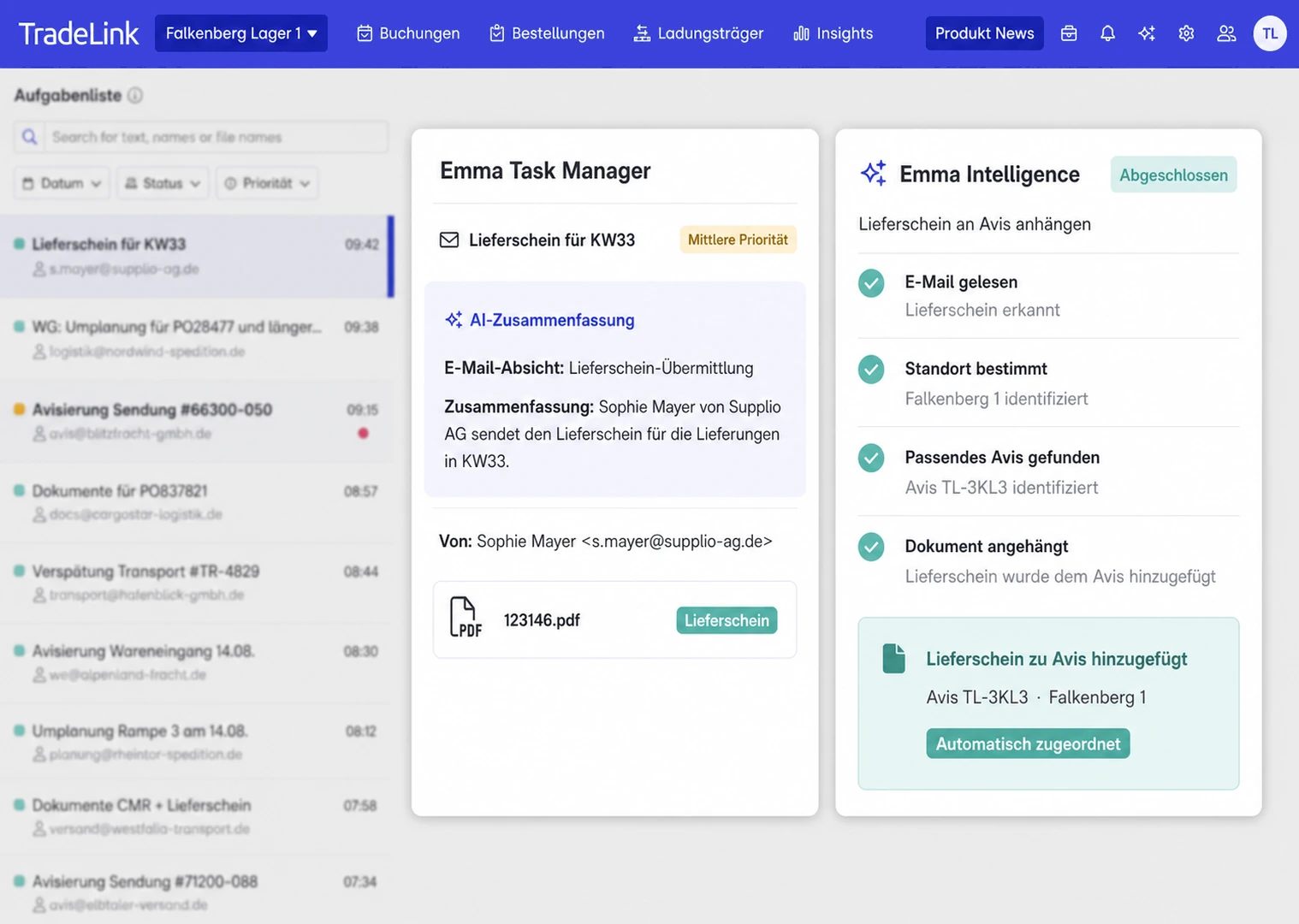
TradeLink makes this possible: With our software, you can increase productivity in warehouse logistics, reduce costs in goods receipt and dispatch processes, and benefit from lower demurrage charges and incorrect charges.
How does it work? The software not only simplifies and partially automates coordination tasks, but also provides all stakeholders with the necessary information from a single, central source. All warehouse documents are consolidated in one clear, cloud-based tool. External suppliers and business partners can easily access the information using their personal login—without any complex IT implementation and, of course, in full compliance with GDPR.