Introduction to Inventory Turnover
Definition of Inventory Turnover
Inventory turnover is a key performance indicator that measures how many times a company's total inventory is sold or replaced over a specific period, typically one year. This metric is crucial for evaluating the efficiency of inventory management and provides insight into how well a company utilizes its resources. Optimizing inventory turnover is therefore a critical aspect of modern supply chain management.
Why is inventory turnover important for businesses?
Inventory turnover is critically important for any company that stores, processes, and sells products for several reasons:
- Reducing capital commitment: The faster a company can turn over its inventory, the less capital is tied up in unsold goods. This improves liquidity and allows the company to invest the freed-up capital elsewhere.
- Lowering storage costs: High inventory turnover rates are often associated with lower carrying costs, as less space and fewer resources are required for storage.
- Ensuring freshness and quality: In industries such as food and fashion, where products are subject to rapid spoilage or changing trends, a high inventory turnover helps maintain the freshness and relevance of the product range.
- Better meeting customer needs: Efficient inventory turnover ensures that products are actually available when they are in demand. This secures customer satisfaction and reduces the risk of stockouts.
- Market adaptability: Companies with high inventory turnover are more agile. They can react more quickly to market changes. They can adopt new trends and adjust their product lines accordingly without having to manage obsolete stock.
How do you calculate inventory turnover?
The formula for calculating inventory turnover
Inventory turnover is determined using the following simple formula:

- Revenue: Revenue represents the total value of goods sold during the period under review. In some cases, "cost of goods sold" is used instead of revenue to obtain a more precise assessment of the so-called cost of sales.
- Average inventory: This is calculated by adding the value of the inventory at the beginning of the period to the value at the end of the period and dividing the result by two. It may also be useful to use a shorter period, such as a monthly or quarterly average, if inventory levels fluctuate significantly.
Step-by-step guide to calculation with examples
The following step-by-step guides show how to calculate and interpret inventory turnover in various business contexts. Adapting this calculation to individual circumstances and industry standards is important for accurate analysis and successful inventory management.
Example 1: Retail store

The result means that the retail store turns over its entire inventory approximately 5.56 times per year.
Example 2: Manufacturing company
- Cost of goods sold: 1,200,000 euros.
- Monthly inventory levels: January: 150,000 euros, February: 130,000 euros, ..., December: 140,000 euros.
- Average inventory: Average of monthly inventory levels over the year.
We calculate the average inventory by adding up all monthly inventory levels and dividing by 12:

This means the manufacturing company turns over its inventory approximately 8.57 times a year, which indicates efficient inventory management and fast production cycles.
The importance of inventory turnover
How does inventory turnover affect business efficiency?
Inventory turnover is a key indicator of inventory management efficiency and therefore has a direct impact on a company's financial health and operational performance. A high turnover rate suggests that a company is managing its inventory effectively. This leads to several positive effects:
- Improved cash flow position: By selling stored goods faster, tied-up capital is reduced, which improves the company's liquidity and frees up funds for other operational investments or debt repayment.
- Lower storage costs: Rapid turnover reduces the costs associated with storing products, including rent, insurance, and spoilage. This leads to a reduction in total operating costs.
- Minimizing losses from write-downs: Products that are turned over quickly are less likely to become obsolete or outdated, which is particularly advantageous in fast-paced industries such as technology or fashion.
Comparing inventory turnover across different industries
Inventory turnover can vary significantly depending on the type of industry, the products, and market dynamics. An industry comparison provides an important benchmark for evaluating your own inventory turnover:
- Retail: In retail, especially with perishable goods like groceries, a high inventory turnover is crucial to ensure product freshness. Supermarket chains often aim for high turnover rates to minimize product losses and maximize freshness. Reliable and forward-looking planning of incoming goods is a fundamental prerequisite for this.
- Fashion industry: In the fashion industry, where trends change rapidly, high inventory turnover is also critical to success in order to avoid write-downs on goods that are no longer in demand and to be able to react to new trends.
- Heavy industry: In industries such as mechanical engineering or steel production, inventory turnover can be lower because products often have longer manufacturing times and are customized based on project specifications and made-to-order requirements. Nevertheless, especially in incoming goods planning, care must be taken to ensure that storage areas do not become overcrowded and that critical production parts are not missing, so as not to jeopardize downstream processes.
- Pharmaceutical industry: In the pharmaceutical sector, turnover is often medium-high, as there is both a need to make critical medications available quickly and a requirement to comply with strict regulations regarding storage and shelf life.
Optimizing inventory turnover
Best practices for improving inventory turnover
Below are some proven methods that companies can use to optimize their inventory turnover:
- Just-in-time deliveries: By reducing inventory levels and synchronizing deliveries with production demand, companies can minimize storage costs while simultaneously increasing efficiency.
- Improved demand forecasting: Using advanced analytical tools to more accurately predict customer demand can help avoid overstocking and increase the inventory turnover rate.
- Warehouse management automation: Modern warehouse management systems (WMS) can help manage inventory more efficiently, reduce storage time, and increase productivity.
- Supplier diversification and shorter procurement cycles: By working with multiple suppliers and optimizing procurement times, companies can increase flexibility and reduce the risk of inventory shortages.
- Regular review and adjustment of inventory: Companies should regularly review and adjust their inventory to ensure it meets current market demands.
Innovative strategies and technologies
To increase inventory turnover, companies can leverage a range of innovative strategies and technologies aimed at boosting efficiency and accuracy in warehouse management:
- Use of RFID technology: Radio Frequency Identification (RFID) enables faster and more accurate tracking of warehouse movements. By automatically identifying and locating items in the warehouse, companies can update their inventory in real time and improve stock control.
- Drone technology for inventory processes: Using drones for inventory counts can significantly reduce the time required for stocktaking while increasing accuracy. Drones can reach hard-to-access areas and improve safety during inventory audits.
- Advanced analytics and machine learning: By using advanced analytics, companies can identify patterns and trends in their sales data that can be used to optimize inventory levels. Machine learning can help refine demand forecasts and improve inventory turnover through more precise ordering processes.
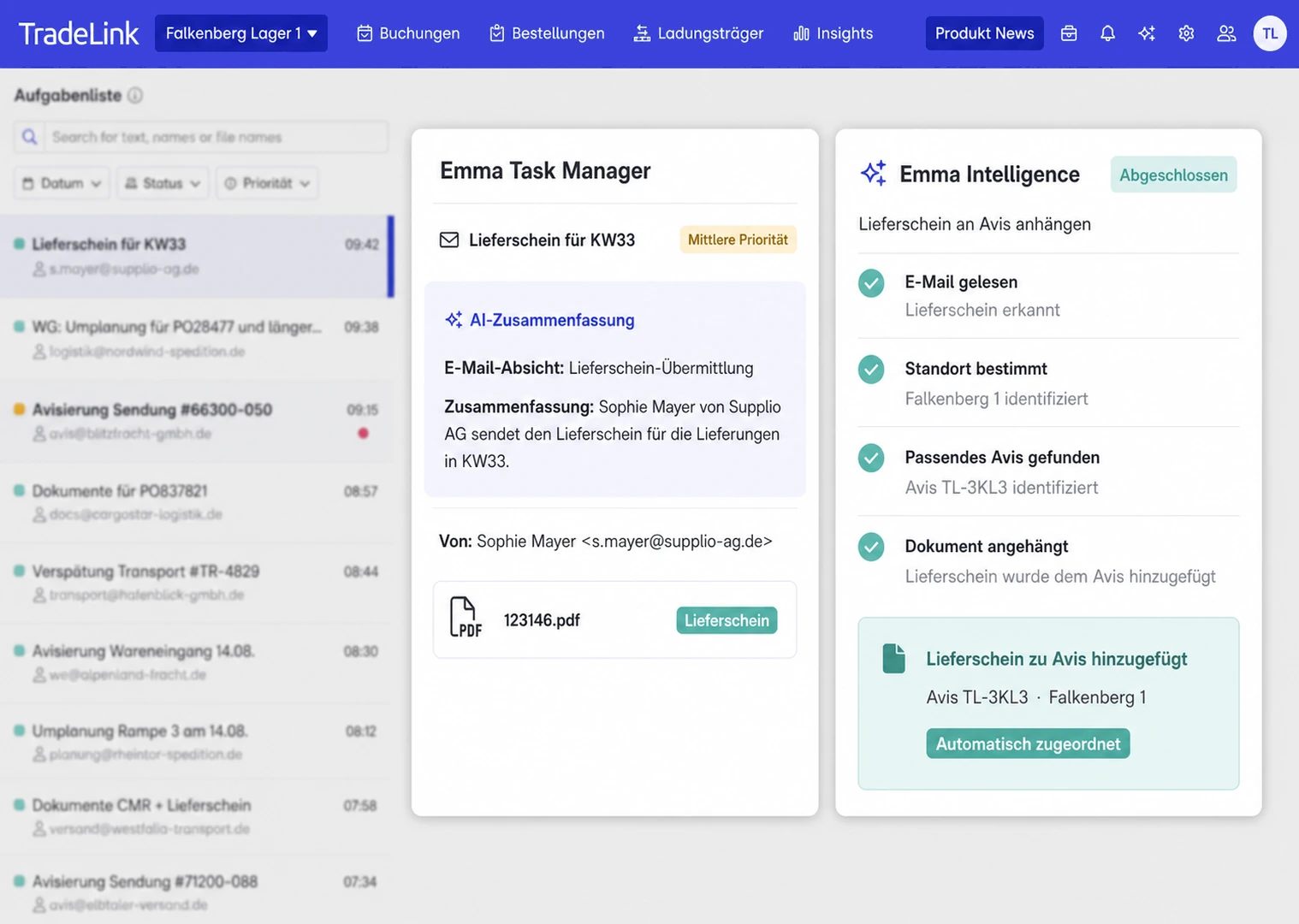
- Optimizing goods receipt: Modern software solutions for supplier management and time slot management increase transparency regarding the flow of goods and help bridge the gap between ordering and shipping notifications. This makes downstream processes in production and customer delivery reliably plannable, while saving valuable storage space.
Conclusion
Inventory turnover is a critical metric that not only provides insight into the efficiency of warehouse management but also has a direct impact on a company's financial health. It helps reduce tied-up capital, lower storage costs, and increase market adaptability.
A company that continuously analyzes and optimizes its inventory turnover can not only minimize losses from obsolete or overstocked products but also increase customer satisfaction through improved product availability. However, industry benchmarks show that there is no single "optimal" inventory turnover rate, as it depends heavily on the nature of the business and the products involved.
Improving inventory turnover requires a holistic strategy. Proven methods such as digital goods receipt planning, just-in-time deliveries, improved demand forecasting, and automated warehouse management offer valuable support. Innovative technologies like RFID, drones, and advanced analytics can further increase the efficiency and accuracy of warehouse management.
Ultimately, the success of achieving a higher inventory turnover depends on a company's ability to regularly review its processes, react flexibly to market changes, and utilize innovative strategies. More efficient warehouse management leads to better results, increases competitiveness, and contributes to the sustainable improvement of company performance.