Professional supplier management is about more than just purchasing today—it is a key success factor for stable supply chains, quality assurance, and partnerships based on mutual respect. ISO 9001 provides a binding framework for making quality measurable and managing processes efficiently. In this article, you will learn what supplier management entails, the role ISO 9001 plays, and how companies can successfully implement this standard in their day-to-day operations.
Table of contents:
- What is ISO 9001?
- What is supplier management? Definition
- How does ISO 9001 affect supplier management?
- How do companies implement ISO 9001 in supplier management?
- How can collaboration with suppliers be regulated?
- Successfully implementing ISO 9001 and relationship management
Don't feel like reading? Book a no-obligation, free consultation with our team of experts now.
What is ISO 9001?
The international standard EN ISO 9001 defines the minimum requirements for a quality management system. It is designed to improve a company's performance at all levels, including supplier management. Seven core principles apply:
- Customer focus
- Leadership
- Engagement of people
- Process approach
- Improvement
- Evidence-based decision-making
- Relationship management
Any company that outsources parts of its value chain to external service providers is expected by the standard to ensure the performance of its suppliers by evaluating them against specific quality criteria. This continuous improvement process focuses on optimizing workflows and processes with regard to product quality and customer satisfaction.
The last version of ISO 9001 was updated in the autumn of 2015. The goal of this update was to respond to changing market requirements, increasingly interconnected trade in the context of globalization, and the overall growing complexity of products and services. Following a three-year transition period, the new ISO 9001 has been in effect since September 2018. Consequently, supplier certification has been mandatory since that time.
What is supplier management? Definition
In general, the term supplier management in logistics describes the systematic control of the relationships between a company and its suppliers. It is usually based in the purchasing department and encompasses various aspects that vary in scope depending on the company.
Within a company, supplier management is responsible for tasks including:
- Selecting suitable suppliers for the supplier base
- Conducting supplier audits
- Evaluating suppliers
- Performance monitoring
- Supplier development
Supplier management aims to establish a coordinated interface with external service providers and optimize the company's own value chain by comparing different vendors. Constant analysis of new suppliers makes their performance comparable and assists in economic process optimization and cost reduction.
The goal of professional supplier management is to build and maintain a competent supplier base whose members are characterized by reliability, performance, continuity, and supply readiness.
How does ISO 9001 affect supplier management?
Section 8.4 of DIN EN ISO 9001 requires companies to monitor the quality of externally provided products and services. This point primarily concerns collaboration with suppliers, for whom the company must establish appropriate criteria. Supplier management processes include the selection of suitable suppliers, supplier assessment and performance monitoring, and supplier development.
Supplier selection
Before a company begins working with suppliers, it must conduct a supplier selection process. This focuses on questions such as what requirements a supplier must meet to qualify as a provider for the company. It must also be determined how the company will verify and document compliance with these requirements.
Supplier assessment and performance monitoring
Supplier assessment and performance monitoring involve determining when and how these processes should take place, which criteria should be used as a basis, and the guidelines and content for auditing business partners.
Supplier development
The next step in supplier development is to draw conclusions from the insights gained during supplier assessment: What measures will be defined and implemented? When will a re-evaluation take place as part of supplier management? It should also be established which performance deviations will lead to the termination of a partnership or supplier relationship, and when and how this will occur.

How do companies implement ISO 9001 in supplier management?
While ISO 9001 requires companies to establish and implement criteria for supplier selection and assessment, it does not provide specific instructions on exactly how such a selection process must look. For smaller companies, it may be sufficient to categorize suppliers into specific groups or classes. For large corporations, however, such a classification can quickly become very time-consuming.
To keep the effort manageable while ensuring a sound assessment, companies should define approximately ten criteria. These include, for example:
- Quality of delivered products, services, and additional support
- Price of purchased products and services
- Competence regarding delivery quantities, delivery dates, and delivery flexibility
- Risk potential of a possible supplier failure
- Consequences of failing to meet requirements
- Trust and reliability in the partnership
- Company dependency on the supplier
- Supplier process quality
Supplier selection and evaluation is no longer just about checking the actual products, but also the associated (delivery) processes, which is best implemented through logistics.
How can collaboration with suppliers be regulated?
Companies looking to build a long-term relationship with a supplier should define the details of that collaboration in a contract—especially regarding ISO 9001 requirements. This is made possible by a Quality Assurance Agreement (QAA). It specifies in detail what the supplier must contribute to quality assurance and which guidelines they must follow. The provisions of a QAA are comparable to a company's general terms and conditions or purchasing terms.
Book a non-binding, free consultation with our team of experts now.
A QAA should cover the following points:
- Goals of the collaboration (regarding the quality assurance of products, services, and processes)
- Consequences of non-compliance (with reference to regular supplier audits)
- Quality management system practiced by the supplier (with documentation)
- Reporting obligations (in the event of non-compliance with agreements or quality defects)
- Feasibility (verifying whether the supplier is actually capable of implementing the requirements)
- Employee qualifications (agreement on the deployment of highly qualified personnel)
- Approval and release (of products, services, processes, procedures, methods, and equipment)
- Measures for quality defects (including immediate notification requirements and defect rectification)
- Review of the quality management system by the company
- Continuous improvement (e.g., through audits)
Successfully implementing ISO 9001 and relationship management
Certification according to DIN EN ISO 9001 builds trust in the quality and performance of your products and services. When it comes to quality and supplier management, it’s just like software: every single employee must be convinced of the system—otherwise, the implementation will not achieve the desired success. To distribute the optimal improvement strategy across all areas of the company, all employees should be integrated into the planning processes.
However, collaboration between various stakeholders and partners plays an important role not only in the context of supplier management and ISO 9001, but along the entire value chain. Professional quality management can only be guaranteed if suppliers, freight forwarders, and employees are networked with one another and informed about ongoing processes.
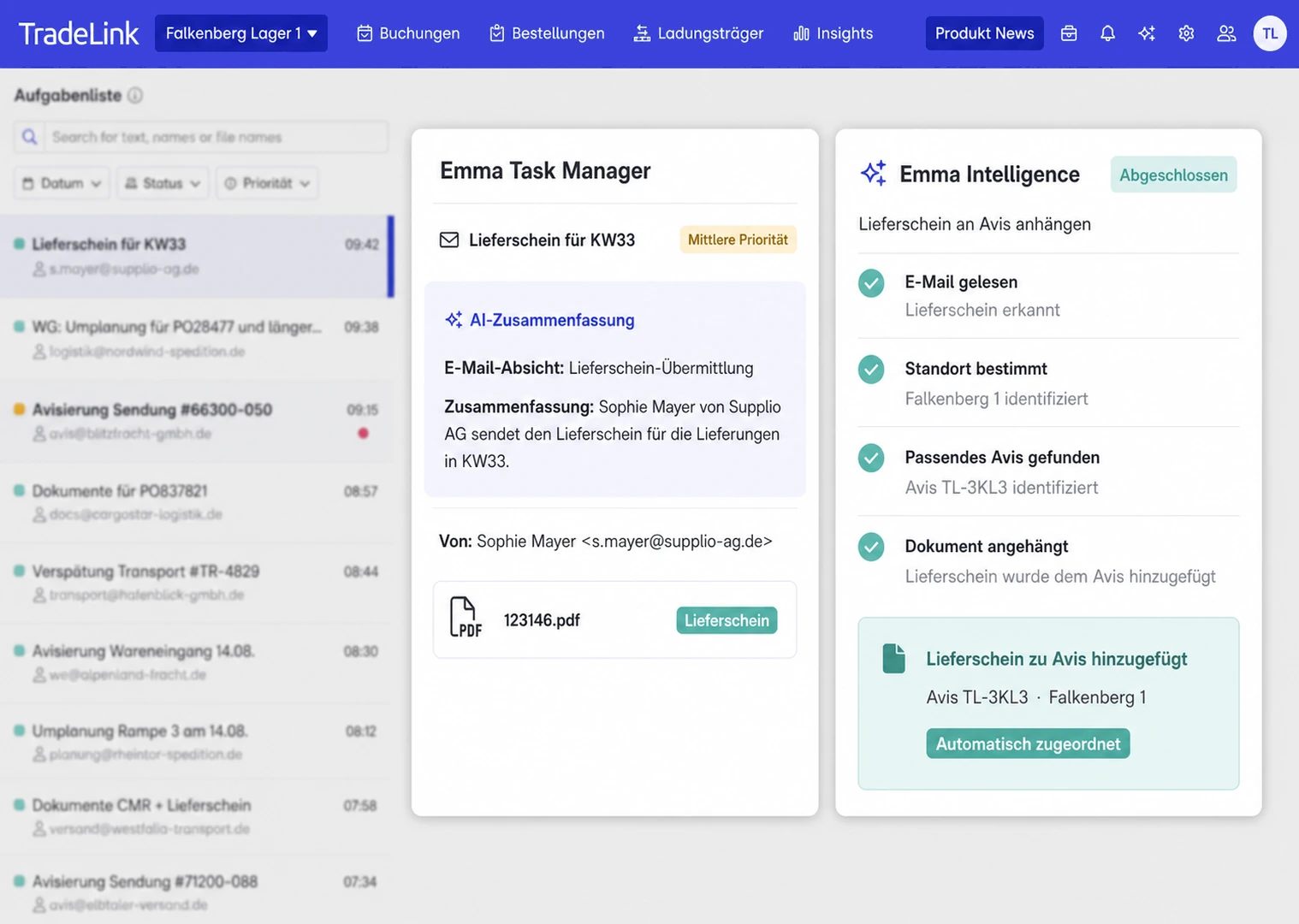
TradeLink’s cloud-based platform makes this possible: with our software, you benefit from maximum transparency along the entire supply chain through superior data quality. All involved stakeholders can track the status of suppliers in real time—whether in purchasing, logistics, or sales. Since TradeLink software is optimized for every device, it doesn’t matter where employees or suppliers are located.
Conclusion: How to succeed in modern supplier management
Supplier management according to ISO 9001 is not a bureaucratic burden, but a lever for greater efficiency, quality, and resilience in the supply chain. The keys to success are:
- A structured, assessable process
- Clear responsibilities
- Transparent communication
- Digital support for implementation
With TradeLink as a digital collaboration platform, companies gain a central interface for supplier management, quality control, and real-time communication—cloud-based, mobile-accessible, and data-driven.
Book a non-binding, free consultation with our team of experts now.