One hundred and twenty: that is the average number of internal and external partners a company's logistics team must coordinate with. 80% of these interactions take place via email, phone, or fax. Companies that fail to optimize their delivery coordination lose 5.1% in EBIT, while those that tackle this process achieve an EBIT growth of 4.9%. In this article, we explain exactly what we mean by delivery coordination, the challenges it presents, and how they can be solved.
Table of contents:
- Delivery coordination: Definition
- Challenges in delivery coordination
- Optimizing delivery coordination with time slot management
- TradeLink: The most effective form of delivery coordination
Delivery coordination: Definition
A warehouse is in constant motion: goods are delivered, transported to their storage location, and later picked up again. Each time, coordination with the carrier or truck driver is necessary to know exactly when goods are being delivered or collected. After all, truck idle times should be kept to a minimum to ensure quick departures and efficient transport. However, the communication involved in this process—delivery coordination—is usually anything but efficient.
Typically, delivery coordination consists of many small steps: the delivery notification, the daily communication of the time slot, coordination upon arrival—and often the notification of delays. In four out of five cases, this delivery coordination takes place via email, phone, and fax. In this day and age, this form of communication seems long outdated.
Challenges in delivery coordination
As mentioned at the beginning, companies must regularly coordinate with an average of 120 internal and external logistics partners. Internally, this includes departments such as purchasing, supply chain management, transport management, production, or sales. External partners include carriers, suppliers, and other 3PL providers.
This multitude of partners makes delivery coordination a challenging process for many reasons. Primarily, it is a major time-sink. Depending on the size of the company, hundreds of emails, calls, or faxes can easily be exchanged daily, each requiring the attention and time of both a sender and a receiver.
But it is not just time that plays a role here: the exchange of information must be followed by the rapid coordination of all involved parties. Warehouses must be prepared for the arrival of trucks, and drivers need to know which bay is assigned to them and what they need to keep in mind during arrival and processing—after all, every warehouse operates differently.
When many people are involved in the process with little automation, the susceptibility to errors increases. Information gets lost, wrong decisions are made, and idle times grow—resulting in lower throughput.
Optimize delivery coordination with time slot management
The primary task of time slot management is to optimize delivery coordination. The term "time slot management" encompasses the coordination of all loading and unloading processes at the loading dock.
The goal is to control the time windows for truck arrivals and unloading as precisely as possible, as well as to plan the loading and departure of trucks. If errors occur and more trucks are expected in a time slot than can be processed, they are forced to wait—increasing dwell times and subsequently incurring demurrage charges. This is because the timely processing of trucks is the responsibility of the warehouse manager. Furthermore, if dwell times exceed a reasonable period, the manager must pay demurrage fees to the transport companies.
Optimized delivery coordination and the resulting reduction in dwell times save companies money directly—and indirectly as well. Effective planning and punctual processing offer many advantages:
- Dwell times and the associated demurrage charges are reduced.
- Reliable planning allows for more trucks to be loaded and unloaded within the same timeframe. This increases throughput and enables more efficient use of personnel.
- The loading dock remains calm: every employee knows what to do and can carry out their tasks with care.
- Satisfaction among external delivery partners increases. This leads to better terms and fosters a relationship built on trust.
- Fewer truck parking spaces and staff members are required, increasing resource efficiency.
Internal processes are simplified and relationships with external partners are improved. But how can time slot management—and thus delivery coordination—be optimized?
Reduce demurrage and dwell times with electronic time slot management
Coordination is considered the greatest challenge in time slot management. Email, phone, and fax seem outdated for this purpose: the effort required to coordinate individually with each of the 120 internal and external partners is simply too high. Digitalization offers a solution: intelligent digital processes simplify and partially automate coordination.

TradeLink: The most effective form of delivery coordination
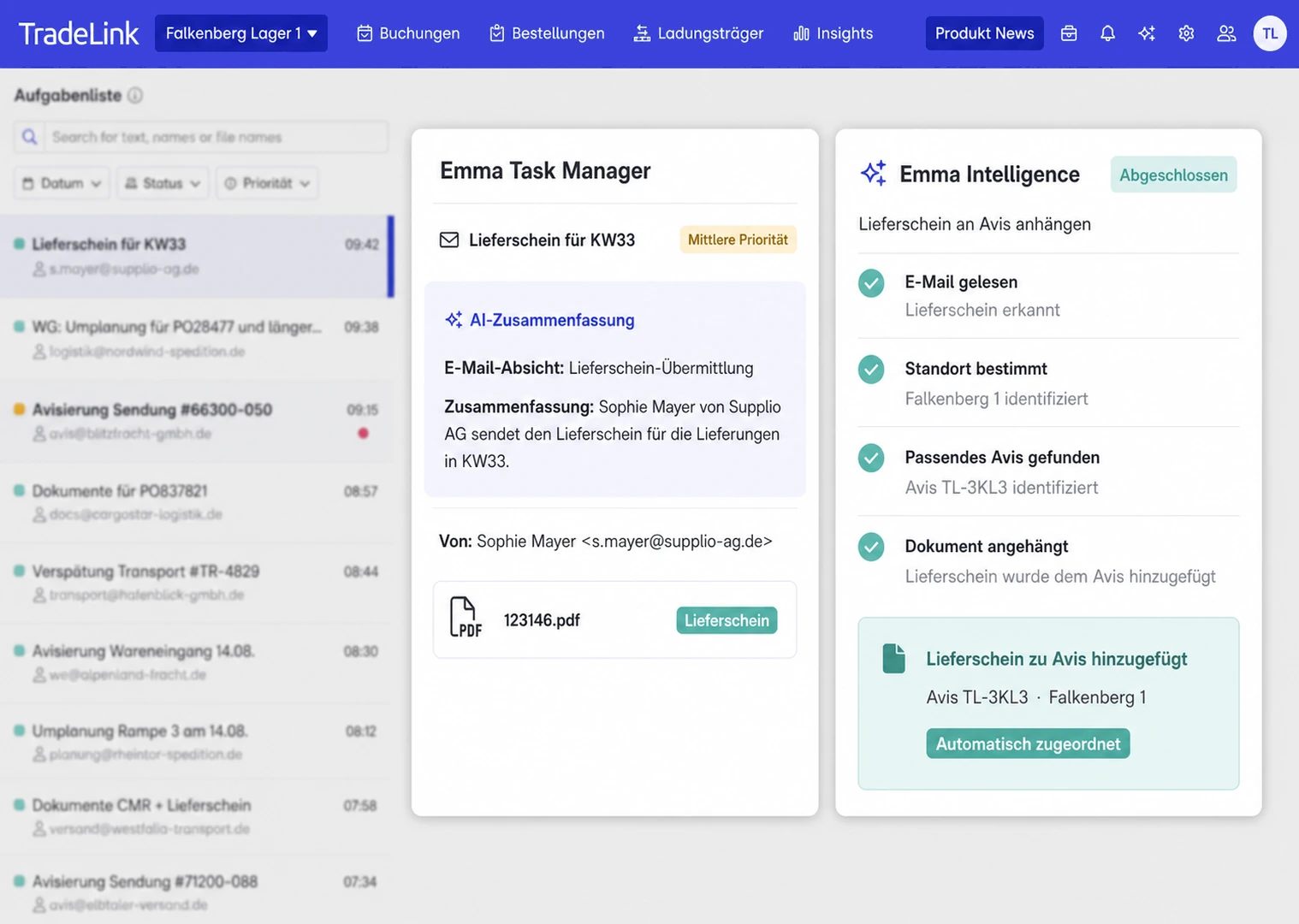
With TradeLink, we have taken on this exact challenge and digitized delivery coordination. The result is a platform that replaces email, phone, and fax for time slot management. We call this #collaborativelogistics.
On TradeLink, all internal and external partners come together to manage their delivery coordination—without the need to install complex software. On this cloud platform, you can map all your logistics processes in detail in one location, configure them flexibly, and integrate them into your daily workflow without any extra effort.
Smart software for time slot management
Suppliers can independently book available time slots at your warehouse. Appointments, rescheduling, and confirmations are automatically sent to all relevant partners, and schedules are updated in real time to reflect any changes. This ensures everyone involved always knows exactly what is happening, when, and where.