The core problem: Logistics processes collapse too quickly under real-world volatility
Most sites today are highly susceptible to disruption. Even minor deviations are enough to derail entire daily schedules:
- A late truck.
- A partner providing incorrect documents.
- A shift supervisor having to juggle two roles simultaneously due to staff shortages.
- A peak day that is 15% above normal.
These micro-disruptions trigger chain reactions: wait times increase, docks are prioritized incorrectly, employees scramble to catch up – and the site loses control.
This leads to what logistics managers describe to us time and again in our conversations:
Our processes are so fragile that even small errors cause everything to falter.
The root causes: Lack of transparency, manual processes, and no scalability
What really causes this susceptibility to disruption is not an individual problem – it is structural:
Cause 1: Lack of real-time transparency
- No overview of wait times, capacity utilization, or arrival times.
- Status information is scattered across Excel, email, phone calls, and manual lists.
- Responses are reactive – not proactive.
Cause 2: Too many manual process steps
- Employees serve as "buffers" for process weaknesses.
- Every deviation leads to inquiries, reprioritization, and frantic coordination.
- Logistics is effectively running in "firefighting mode."
Cause 3: Skilled labor shortages exacerbate vulnerabilities
- Fewer staff = greater reliance on stable processes.
- At the same time, internal pressure to digitize is rising, and benchmarks are becoming tougher.
Cause 4: Systems are not built for scaling
- Many locations have tools for specific process areas (transport, booking, planning), but no site-wide management system.
- As a result, end-to-end data flows that enable reliable decision-making are missing.
The result: increased risk, growth bottlenecks, operational instability
When processes are not stable, many things often happen at the same time.
A) Operational risks increase
- Unused loading docks despite trucks waiting.
- Overloaded shifts on peak days.
- Unpredictable wait times that ruin costs and morale.
- Stressed employees, high absenteeism.
B) Strategic growth goals are jeopardized
Locations that cannot scale limit the entire company.
- No expansion of product ranges or customer base possible.
- External warehouses have to be opened at great expense, even though the existing site has sufficient potential.
- Management is losing confidence in logistics.
C) The site loses resilience
Without proactive data management, logistics remains a "black box." And that is exactly where the greatest long-term costs arise.
The solution: Modern process reliability through transparency, standardization, and real-time control
Robust logistics are not created by more people or more meetings – but by structured processes + real-time data + collaboration.
The lever is a platform that:
- Provides real-time transparency regarding capacity utilization and waiting times
- Standardizes inbound/outbound processes
- Makes time slots reliable and tactically manageable
- Centralizes communication instead of spreading it across 6 channels
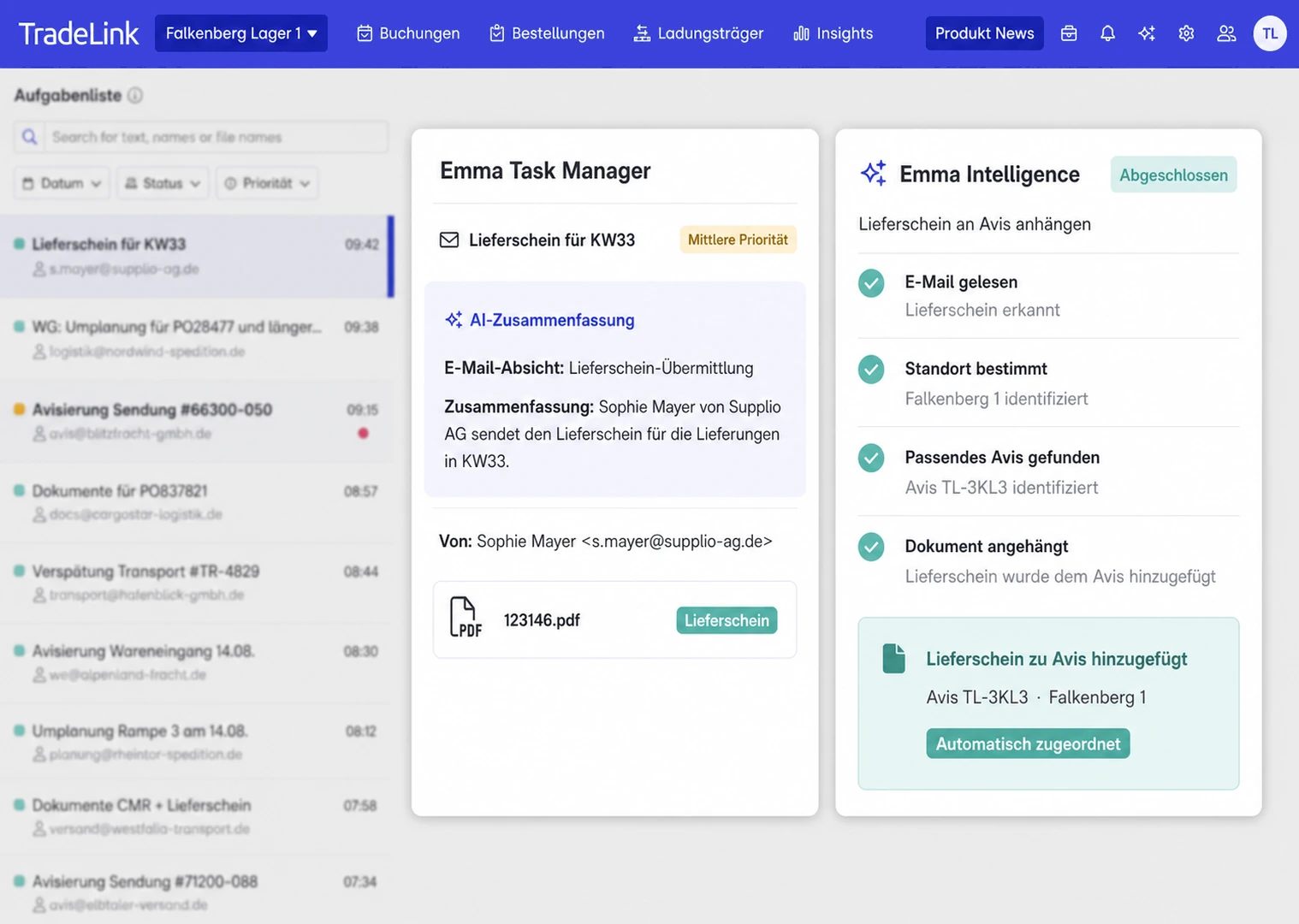
- Automates tasks where manual "gap-filling" currently takes place
Result:
Sites save up to 25% in administrative effort – which directly counteracts the shortage of skilled workers.
What specifically stabilizes:
Process control
- Before: reactive, unpredictable
- After: proactive, KPI-based
Communication
- Before: chaotic, manual
- After: consistent, transparent
Employee retention
- Before: overloaded, firefighting mode
- After: relieved, structured daily routine
Resource planning
- Before: gut feeling
- After: 14–30 days lead time
Ramp usage
- Before: inefficient
- After: balanced capacity utilization
1. Real-time information flow
    ↓ (everyone provides status data to a central platform)
2. Automated pre-planning
    ↓ (time slots, volume forecasts, capacity models)
3. Daily operations management
    → Live monitoring
    → KPI heatmaps
    → Rule-based routing
4. Deviation management
    → automatic escalations
    → proactive partner communication
5. Continuous optimization
    → Key metrics: waiting time, capacity utilization, on-time delivery
    → Site management via unified reporting
Stability is achieved when planning, execution, and tracking are interconnected—not treated as isolated steps.
Case study: How one facility reduced its downtime risks by 30%
A mid-sized production facility faced exactly the challenges described above:
- High volatility in inbound logistics
- Manual management via Excel
- No unified view of capacity utilization
- Shortage of skilled workers in planning and administration
- Annual peak-season breakdowns
Implementation steps:
- Fully standardized time-slot booking
- Centralized communication instead of Excel and phone calls
- Real-time KPIs for wait times and capacity utilization introduced
- Automated deviation management
- Supplier training (10-day rollout)
Results after 6 weeks:
- 25% reduction in administrative workload
- Consistently stable inbound processes—even with a 20% increase in volume
- Significant improvement in supplier on-time performance
- Substantial decrease in unplanned downtime
The facility was able to realign its production schedule without requiring additional resources.
Conclusion: Process reliability is the new competitive factor
Stable locations scale. Volatile locations hold the entire company back. Process reliability is not just a "nice-to-have," but:
- Risk mitigation
- Skilled labor strategy
- Cost lever
- Competitive factor
- Foundation for AI-supported logistics
If you want robust logistics, you need:
Transparency + standardization + real-time control + collaboration.