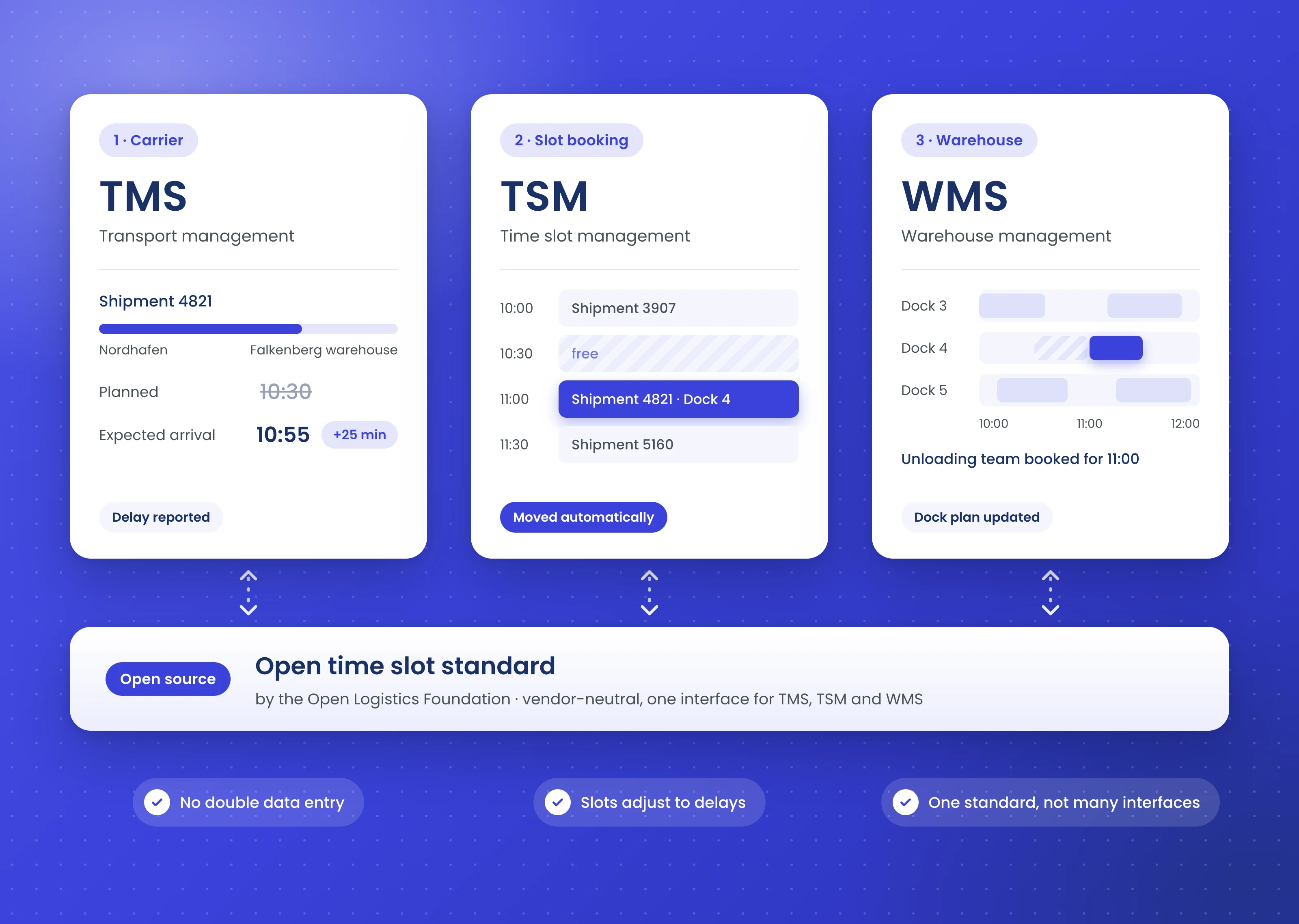
Here is a familiar example from logistics. A carrier books a time slot in its own system. If the shipper uses a different system and the two cannot communicate directly, someone usually has to transfer the booking details manually. That creates extra work and slows down automation.
An open API addresses this problem by giving different systems a shared interface for exchanging information in a standard format, regardless of the software provider. Teams spend less time transferring data manually and can automate more of the work that spans multiple systems.
For the solution to work in practice, the industry needs to develop it together. That is why TradeLink is working with the Open Logistics Foundation on an open Time Slot Management API. David Bauske, TradeLink’s Head of Engineering, leads our work on the project.
Industry-wide challenges need shared solutions
TradeLink works to improve collaboration in logistics and break down existing silos. We want to make data easier to exchange and help everyone involved work together.
We believe that takes a standard developed with and for the industry. Carriers, shippers, software providers and integrators all need a voice. An open process helps build consensus and lays the groundwork for broad adoption.
We are contributing our experience and our existing API. Our priority is a practical standard that everyone can use.
Less manual work and better planning
A shared standard can simplify day-to-day work. Carriers should be able to keep working in their main system while it communicates with different time slot booking systems. That means less manual data entry and less integration work.
Shippers benefit too. They get the data they need to plan inbound and outbound operations. That depends on coordination across the network. When carriers and shippers both benefit, the entire supply chain works more efficiently. Over time, productivity improves and costs fall. Some carriers have already started implementing the API.
Interoperability as a foundation
Interoperability should be standard practice. TradeLink’s strengths are the breadth of our platform network and AI agents built around the problems our customers face. We want data to move freely between systems.
AI agents can handle routine tasks efficiently and work independently when they can communicate reliably with different systems, including existing legacy software.
Open standards connect systems. AI agents automate the processes between them. Together with the Open Logistics Foundation, we are laying the groundwork for logistics systems to communicate across software providers and for AI agents to work across system boundaries.
Get involved
An open standard benefits from input across the industry. Carriers, shippers, warehouse operators and providers of transport, time slot and warehouse management systems can apply to take part in the pilot until 30 November 2026. Participants bring a use case of their own. The pilots are expected to start in early 2027.
Find out how to apply on the Open Logistics Foundation website